
Everything You Need to Know about Aerospace Part Marking and Traceability
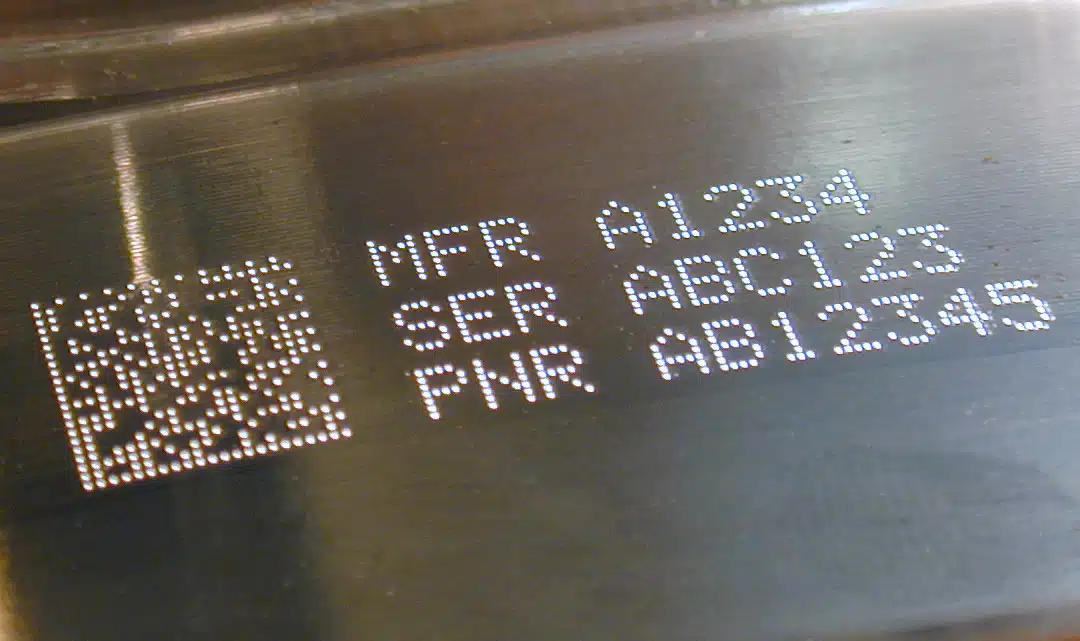
If you manufacture for the aerospace supply chain, you’ll already know that marking isn’t optional. Every component needs a permanent identity that survives machining, heat treatment, coatings, and decades of service, and that identity needs to meet a set of standards that can look bewildering the first time you encounter them.
We’ve spent a long time working in this sector, and we’ve written a fair bit about individual specifications or products over the years. This post pulls that together into one place: why aerospace traceability works the way it does, the standards you need to know, how marking technology has evolved to keep up with increasingly complex and valuable components, and how verification fits into the whole picture.
Why Aerospace Marking Carries More Risk Than Most
Marking doesn’t make an aero engine component stronger, lighter, or more efficient. It adds nothing to the part’s performance. And yet without it, that component can’t be fitted, tracked, maintained, or replaced. It’s one of the few processes in aerospace manufacturing that adds no engineering value but is completely non-negotiable in every other sense.
That identity, usually a combination of human-readable text and a 2D Data Matrix code, acts as a passport for the component. It links the physical part to everything known about its manufacture: the material batch, the machine that cut it, the operator who ran that machine, the inspection results it passed. If a part ever fails in service, that traceability is what allows investigators to work backwards and identify every other component sharing its history.
The stakes are raised further by the value of the parts involved. A finished aero engine disc or BLISK can be worth well over £100,000 by the time it reaches the marking operation, having already absorbed hundreds of hours of machining. A mark applied in the wrong place, at the wrong depth, or with a code that fails verification doesn’t just mean a rework loop. In the worst case, it condemns the component entirely or delays the build programme of an entire aero-engine.
The Standards You Need to Know
Aerospace part marking is governed by a set of international, national, and OEM-specific standards. As a supplier, you’re expected to comply with whichever apply to your customer and component, and they often overlap.
AS9132 is issued by the International Aerospace Quality Group (IAQG) and defines process requirements for the dot marking of 2D Data Matrix codes on metallic parts. It sets out dot size, offset, and angle of distortion limits, and it’s published in three regional formats, AS9132 (Americas), SJAC 9132 (Asia Pacific), and EN9132 (Europe), with identical technical content across all three.
MIL-STD-130 is the US Department of Defense’s standard practice for identification marking of military property, currently at revision N. It’s built around the Item Unique Identification (IUID) system, which assigns a globally unique identifier to every discrete item in the DoD inventory. If you supply into the US defence or aerospace supply chain, this is one you’ll encounter directly. What’s particularly useful to know is that MIL-STD-130 doesn’t require a separate Data Matrix quality process if you’re already working to AS9132: it explicitly accepts an AS9132 pass/fail result as one of three valid routes for grading a Data Matrix mark’s quality, alongside ISO/IEC 15415 and AIM DPM-1-2006. If your verification already produces an AS9132 result, that same result satisfies MIL-STD-130. We’ve covered the standard in full detail in our dedicated MIL-STD-130 guide.
Spec 2000 – SPEC 2000 was created by the airline industry (originally through the ATA, now A4A) to standardise e-business processes, meaning the electronic exchange of business data such as orders, certificates, and maintenance records, across the supply chain. It’s less about the physical mark and more about ensuring the data attached to a part is handled consistently from manufacturer to airline.
Rolls-Royce JES131 and RRES90003 are OEM-specific specifications that most manufacturers working with Rolls-Royce will encounter directly. JES131 defines and controls how Rolls-Royce components should be marked, covering both human-readable and machine-readable methods, and specifying where on the part the mark should go. RRES90003 is the wider Rolls-Royce document covering identification marking methods and controls more generally. Other OEMs, such as Pratt & Whitney, run equivalent specifications of their own (PWA309, PWA310, and similar).
ISO/IEC TR 29158 and AIM-DPM both deal with the quality grading of Data Matrix codes, extending the ISO/IEC standards for printed barcodes to cover dot peen and laser direct part marking specifically.
The practical reality is that most of these standards reference or overlap with each other, and manufacturers rarely need to comply with just one. What matters is having a marking and verification process that can be configured to whichever specification your customer requires, and that produces documented evidence the mark meets it.
Why Dot Peen Is the Aerospace Default
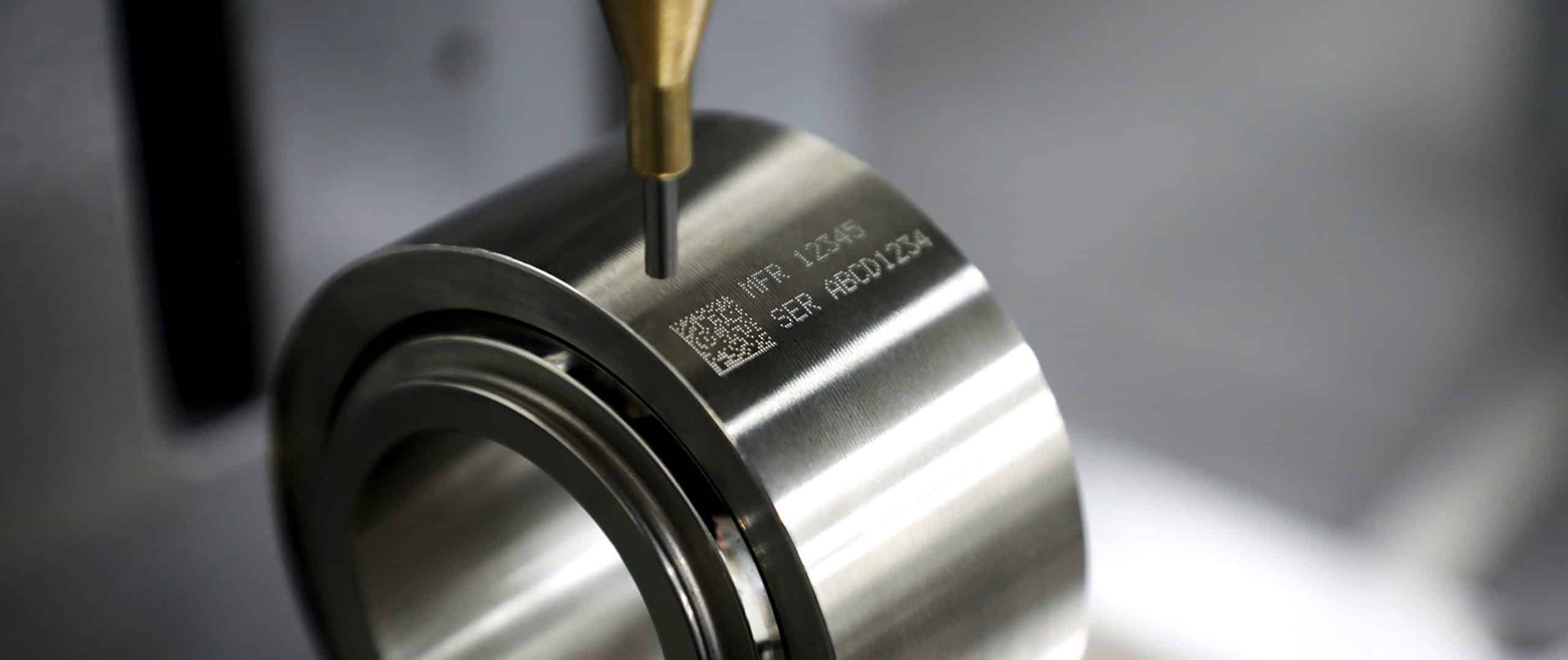
Aerospace manufacturers overwhelmingly specify dot peen marking for direct part marking, and the reason is straightforward. It produces a permanent, low-stress mark on the nickel alloys and titanium these components are made from, and it supports both human-readable text and Data Matrix codes for long-term traceability. Laser marking has its place, but for the discs, rings, casings and BLISKs that make up the bulk of an engine, dot peen remains the standard.
Marking Complex and High-Value Components
An aero engine disc rarely gives you a flat face to work with. Casings, BLISKS and turbine rings come with curves, bores, internal diameters and angled faces that a fixed marking head simply can’t reach. That’s exactly why multi-axis marking systems exist, controlling up to eight servo-driven axes alongside an adjustable turntable, so the marking head and the component can be positioned together for whatever angle the job needs.
Vision plays two roles in this process. Before marking, the camera identifies the part’s own features, such as a datum, bore, or slot, and applies offsets automatically, so the mark goes where the part actually is rather than where a fixture assumes it to be. After marking, the same system verifies the Data Matrix code and human-readable text in the same cycle, catching a bad mark before the part leaves the station rather than three operations downstream, and cross checking the information against the original data set.
For high-volume production, the next step is full automation. Robotic marking cells now handle round and cylindrical components up to around 1.2 metres in diameter as standard, with the robot carrying the marking head to the part rather than the other way around. The most advanced cells operate lights-out, with parts delivered, loaded, marked and verified with zero human input, and multiple marking heads on hand so a worn stylus never compromises a mark. A large BLISK might need 15 or more separate marks, each positioned to a tolerance of 0.1mm. At that scale, manual marking simply isn’t a repeatable positioning system.
Verification Is Not Optional
Marking a part correctly is only half the job. AS9132, MIL-STD-130 and the OEM standards built on both exist because a Data Matrix code that looks fine to the eye can still fail against measured grading criteria for dot size, offset, and distortion. That’s why verification, using a vision system that grades the mark against the relevant standard immediately after marking, has become as much a part of the process as the mark itself. A documented pass, not a visual check, is what a customer or auditor will actually ask to see, modern systems can store a verification report for every single part that passes through the marking station.
Frequently Asked Questions
What is the difference between AS9132 and Spec 2000?
AS9132 governs the physical quality of a Data Matrix mark, covering dot size, offset and distortion. Spec 2000 governs the e-business and data standards around how part information is exchanged across the airline supply chain. They address different parts of the same traceability requirement.
What is MIL-STD-130 and how does it relate to AS9132?
MIL-STD-130 is the US Department of Defense’s standard for identification marking and the IUID system used to uniquely track military property. It isn’t a competing standard to AS9132, it’s complementary: MIL-STD-130 accepts an AS9132 pass/fail verification result as one of its own valid routes for Data Matrix quality grading, so suppliers already verifying to AS9132 don’t need a separate process for DoD-marked parts.
Do I need to comply with more than one aerospace marking standard?
Usually, yes. Most manufacturers need to satisfy AS9132 or its regional equivalent alongside whichever OEM-specific specification their customer runs, such as JES131 or RRES90003 for Rolls-Royce work, and MIL-STD-130 where US defence contracts are involved.
How is a Data Matrix mark verified against AS9132?
A vision system grades the mark against measured parameters, dot size, dot centre offset and angle of distortion, and returns a pass or fail result. This is typically integrated directly into the marking station so verification happens in the same cycle as marking and a report is saved showing the results of each mark.
If you’re specifying or reviewing an aerospace marking process and want to talk through which standards apply to your components, get in touch with our technical team on +44 114 2766044 or via our contact page.