
What Is MIL-STD-130?
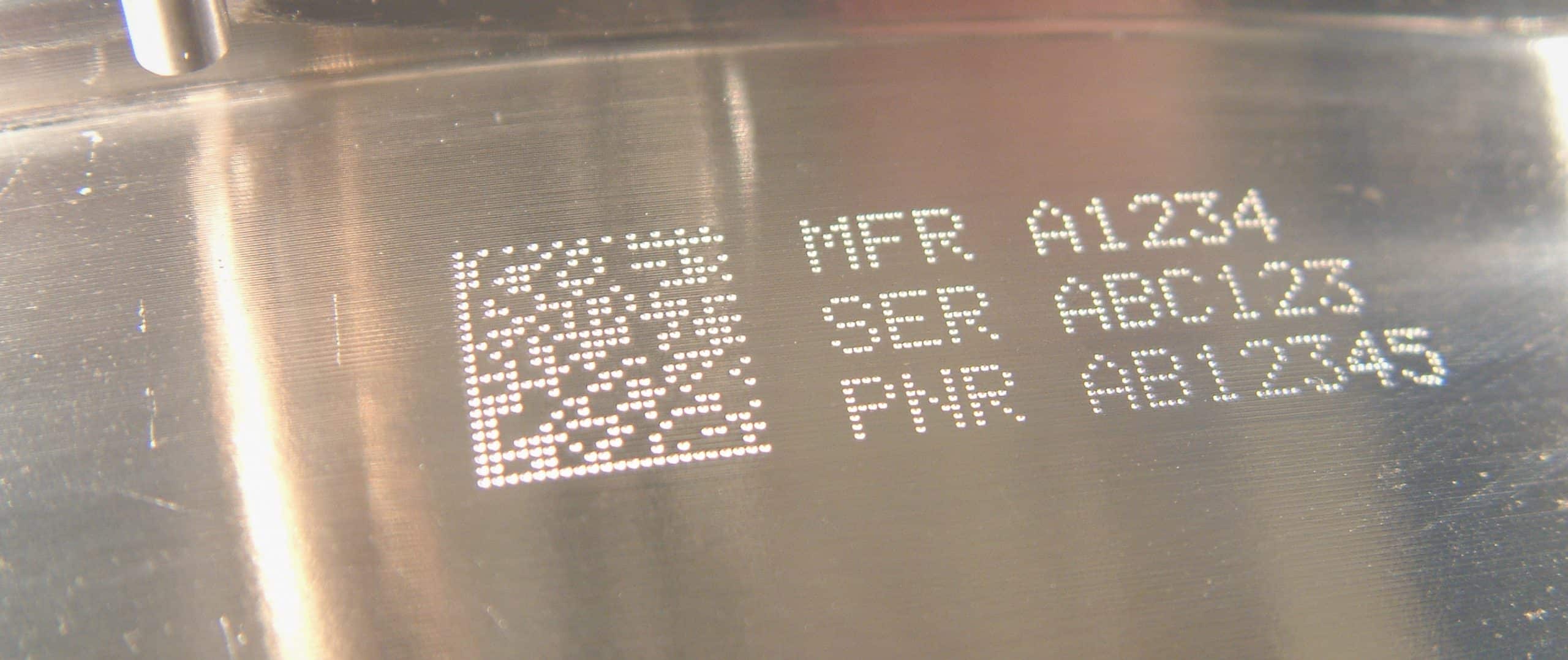 MIL-STD-130 is a US Department of Defence standard practice governing the identification marking of US military property. Its current version, MIL-STD-130N, was issued on 17 December 2007, superseding MIL-STD-130M. It’s approved for use across all Departments and Agencies of the DoD.
Unlike some of the aerospace standards we’ve covered before, MIL-STD-130 isn’t a single fixed specification you simply comply with. It provides the criteria from which product designers and acquiring activities develop their own specific marking requirements, covering content, size, location, application process, and materials. The standard itself is explicit on this point: simply stating that an item should be marked in accordance with MIL-STD-130 is not sufficient for design or contract purposes. The specific requirements still need to be spelled out.
What Does MIL-STD-130 Actually Require?
The standard addresses two categories of marking:
Human-Readable Information (HRI), meaning text intended to be read directly by a person
Machine-Readable Information (MRI), meaning data encoded in a linear barcode or 2D symbol for automated reading
At the centre of MIL-STD-130 is the Item Unique Identification (IUID) system. This is the DoD’s method of assigning a globally unique identifier, the Unique Item Identifier (UII), to a discrete item, so it can be distinguished from every other item in the DoD inventory throughout its life, from acquisition through manufacture, logistics, and eventual disposal.
Where DFARS-mandated IUID marking applies, the minimum machine-readable mark is a Data Matrix ECC 200 symbol, encoded to ISO/IEC 15434 syntax, with the UII itself limited to 50 characters. The Data Matrix module size must fall between 0.0075 inch (0.19mm) and 0.025 inch (0.635mm), with the overall symbol not exceeding one inch square.
Data Matrix Quality: Where MIL-STD-130 Meets AS9132
This is a direct, practical link to a standard our aerospace customers already know well. MIL-STD-130 gives suppliers a choice of three acceptance routes for grading a Data Matrix mark’s quality:
ISO/IEC 15415, requiring a minimum quality grade of 3.0/05/650
AIM DPM-1-2006, requiring a minimum grade of 2.0 under the Direct Part Mark quality guideline
SAE AS9132, using its Pass/Fail visual inspection criteria directly
In other words, if you’re already verifying marks to AS9132 for aerospace work, that same verification can satisfy MIL-STD-130’s quality requirement. You don’t need a separate grading process for DoD-marked parts if AS9132 pass/fail is already part of your line.
Marking Methods MIL-STD-130 Recognises
The standard’s Table II lists a wide range of acceptable marking methods, including dot peening, laser engraving, laser etching, vibro peening, electrochemical etching, and metal stamping, and specifies which of these are suitable for producing 2D symbols. The standard also states directly that automated marking processes are the preferred approach. Section 4.7 names dot peen and laser marking specifically as preferred over manual marking.
MIL-STD-130 Key Points
Issued by the DoD and applicable across all Departments and Agencies
Provides the criteria for developing marking requirements, not a turnkey specification in itself
Built around the Item Unique Identification (IUID) system and the Unique Item Identifier (UII)
Minimum machine-readable mark is a Data Matrix ECC 200 symbol under ISO/IEC 16022
Accepts AS9132 pass/fail as one of three valid Data Matrix quality grading routes
Names dot peen and laser marking as preferred automated marking methods
How Does MIL-STD-792 Fit In?
This is a common point of confusion, so here’s the distinction. MIL-STD-792, currently at revision F and issued by the Naval Sea Systems Command (NAVSEA), is a manufacturing process standard covering identification marking for special purpose components, primarily Navy shipboard parts, piping, and pressure boundary components.
MIL-STD-130 rules out items covered by MIL-STD-792 entirely. These are two separate systems, not one standard building on the other.
Where MIL-STD-130 is concerned with data content and the IUID/Data Matrix system, MIL-STD-792 is concerned with the physical marking process itself: it defines nine permanent marking method types, including electrochemical etching, engraving, laser engraving, and dot matrix (dot peen) marking, each with specific depth and dimensional tolerances. Laser engraving under MIL-STD-792, for example, is limited to a nominal depth of 0.001 to 0.003 inch, with a maximum of 0.005 inch, and requires a formal, NAVSEA-approved qualification procedure before it can be used in production. Dot matrix marking has its own tolerances, nominally 0.001 to 0.002 inch deep, with a defined stylus geometry.
If you’re supplying components into the naval and shipbuilding sector rather than general DoD property, MIL-STD-792 is likely the more directly relevant standard, and it deserves its own detailed guide given how specific its process requirements are. We’ll cover that separately.
Getting Your Marking Process Right
Whether you’re working to MIL-STD-130’s IUID requirements, MIL-STD-792’s process controls, or the aerospace standards this sits alongside, the right marking equipment needs to produce a mark that survives verification against the specific standard your contract calls for.
Get in touch with our technical team on +44 114 2766044 to talk through what your components need to comply with.