
Four in ten UK-built cars are electrified. Origin rules will soon test every part
What the SMMT figures show
SMMT counts battery electric, plug-in hybrid and hybrid cars as electrified. In 2024 they made up 35.4% of UK car output. In 2025 the share reached a record 41.7%, with 298,813 electrified cars built, up 8.3%, in a year when total vehicle output fell 15.5%.
The share has barely moved since. January 2025 came in at 42.2%. Electrified output rose 6.8% in July 2026 to 25,678 cars, the first monthly increase of this year, and the share stayed above 40% in July, August and September. August reached 43.6% and September 42.3%. SMMT’s half-year figures put electrified models at around four in ten cars built in the first half of 2026, so the year-to-date average also sits at around four in ten, even though electrified output was down 8.6% on the first half of 2025 while manufacturers worked through model changeovers. On the demand side, battery electric cars took 28.3% of new UK registrations in September, up from 23.3% a year earlier.
The headline growth needs care. Total UK vehicle production rose 36.3% in September, to 74,031 units, but SMMT says that reflects last year’s cyber incident, which stopped production at Britain’s biggest automotive employer. Across the first nine months, vehicle output is down 3.0%, while car output is up 0.1%.
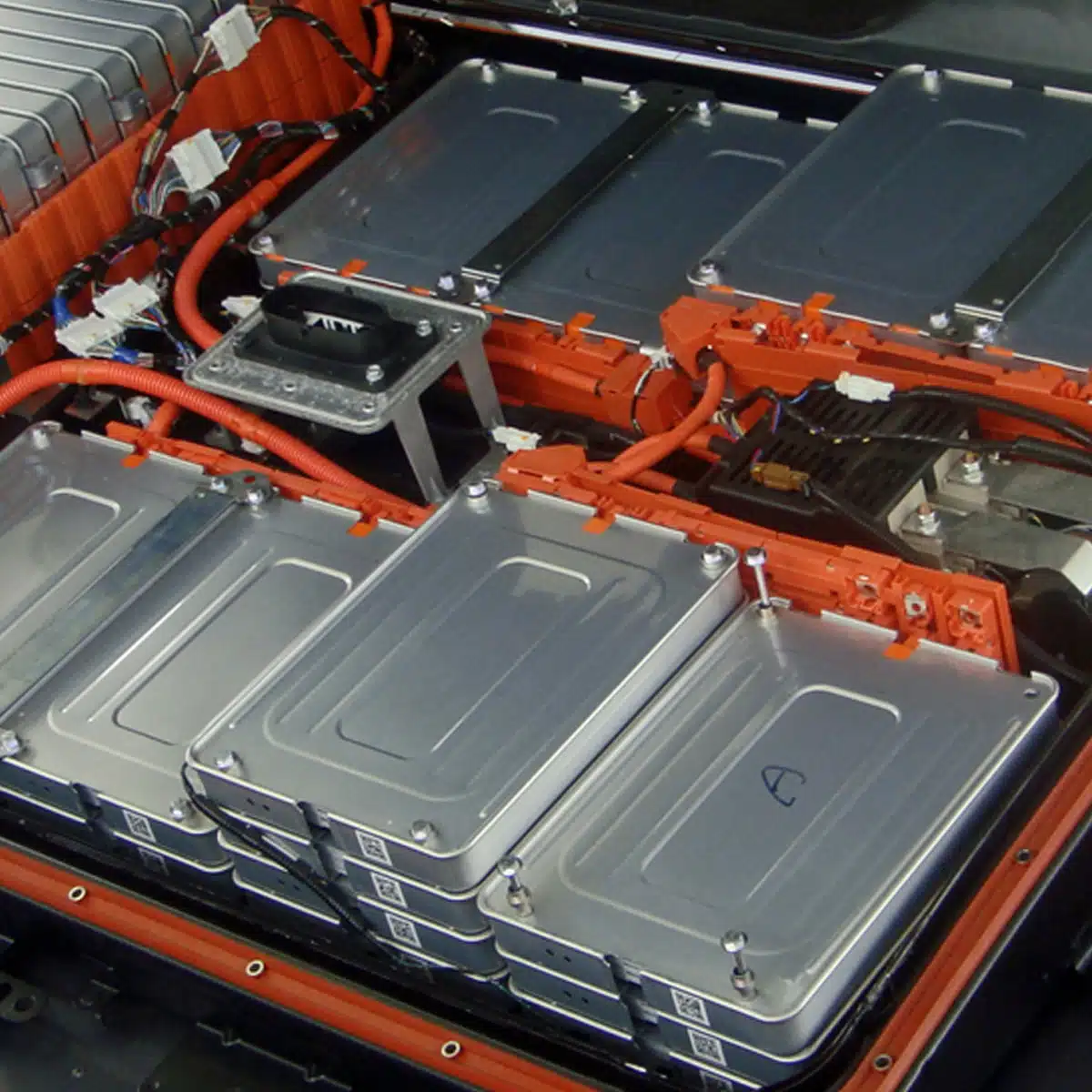
In our view, a steady 42% tells you more than a spike would. Electrified production is the baseline for UK car manufacturing now, and every one of those cars carries a battery that has to be identified, tracked and, from next year, documented.
What electrification means for marking
From 18 February 2027, every EV battery and every industrial battery above 2 kWh placed on the EU market must carry a QR code linking to a Digital Battery Passport. Article 13(7) of Regulation (EU) 2023/1542 says that code must be printed or engraved visibly, legibly and indelibly on the battery itself. That is the line labels can’t cross: a label is attached to the battery, not part of it, and a mark that can be peeled off, scuffed away or lost to heat and chemicals isn’t indelible. UK manufacturers aren’t bound directly, but anyone supplying batteries, or vehicles that contain them, into the EU is.
Indelible line labels won’t do. Adhesive labels peel, and they degrade under heat cycling and chemical exposure over a battery life that can run past 15 years. Laser engraving removes material from the surface and creates a mark that can’t be separated from the part. Our fibre lasers mark most metallic housings, our MOPA lasers mark anodised aluminium without damaging the protective oxide layer, and our dot peen systems mark heavy trays and structural housings.
The harder problem sits at cell level. Annex XIII of the regulation calls for an identifier that allows individual battery tracking, not batch-level tracking. In our experience, the best point to mark a cell is after formation and before module assembly, when the surface is stable and the cell’s capacity data is known.
Speed is the catch. Cylindrical cell lines can run at more than 240 parts per minute. On a line running at 200 cells a minute, the marking station has under 300 milliseconds to position the cell, mark it, verify the code and link the result to the manufacturing execution system. Every code is graded against ISO/IEC 15415, and the result is logged against the cell’s production record, which is how the physical mark stays linked to the passport.
Place of origin and tariffs
Most of what UK factories build leaves the country. SMMT’s September figures show that 76.7% of cars built were exported, and the EU took 57.5% of them. That trade runs under the UK-EU Trade and Cooperation Agreement, and its rules of origin tighten on 1 January 2027, less than two months from now.
SMMT says that without a fix, the tougher rules will bring additional tariffs on the majority of battery electric and plug-in hybrid vehicles traded between the UK and EU, costing at least £1.4 billion. Vehicles that can’t show enough UK or EU content, including an originating battery pack, would lose tariff-free access and face a standard 10% duty. The rules apply in both directions.
A second threat comes from the European Commission’s ‘Made in Europe’ proposals. SMMT says that as drafted they would effectively exclude UK-built vehicles from their largest market, and Fleet News reports a proposed 70% EU-content requirement for electric vehicles. SMMT also puts UK automotive’s contribution to the EU supply chain at €24 billion of economic activity and a quarter of a million jobs.
Origin is a paperwork test, and in our experience a claim is only as strong as the records behind it. Marking doesn’t decide where a part comes from. It ties a specific part to its supplier, batch and process data, so the evidence follows each part through the supply chain. The Battery Passport is built on the same idea: it carries raw material origins, linked to a unique identifier engraved on the battery.
VIN marking: the same discipline on the whole vehicle
A VIN is a vehicle’s 17-character unique identifier. VIN plates and labels also carry market-specific legislative information that supports import and export. With three quarters of UK-built cars sold overseas, we think a clear, permanent and accurate VIN matters at every border.
We know this work well. In 2013, production engineers at Jaguar Land Rover approached us because dot peen marking was too noisy and slow for body panels, and scribe marking needed elaborate, model-specific tooling. Their specification called for a mark 0.3mm deep, so it would resist tampering and stay readable for the life of the vehicle. We built a high-power laser system capable of 0.5mm, mounted it on a robot, and added machine vision to locate each body and verify every mark.
On a steel-bodied vehicle, the laser marks a VIN in four seconds, against 30 seconds for the scribe system it replaced. It can apply the VIN in up to three places on the body in one production cycle, and the vision system checks every vehicle. Rejections for mark quality have fallen since installation. Jaguar Land Rover went on to commission further cells, including one in China, and the system won us a Queen’s Award for Innovation.
That’s a car-body example, but the approach works on a battery line too: a permanent mark that is verified automatically and linked to a data record.
Questions to ask your own line
From today, 18 February 2027 is 15 weeks away. If your line still relies on labels, will they pass the indelibility test in Article 13(7)? Will your current marking method pass it? Can your unique ID management feed a Battery Passport record, down to cell level where you need it? And, if a customer or a customs authority asked for origin evidence on a specific part, could you produce it from the mark?
If any answer is uncertain, speak to our engineers. We design and build every system at our Sheffield headquarters, so the people who answer the phone are the people who built the machine. Call +44 (0)114 276 6044 or email info@pryormarking.com.