
Why Self-Adhesive Labels Fail the EU Battery Regulation
And what to use instead.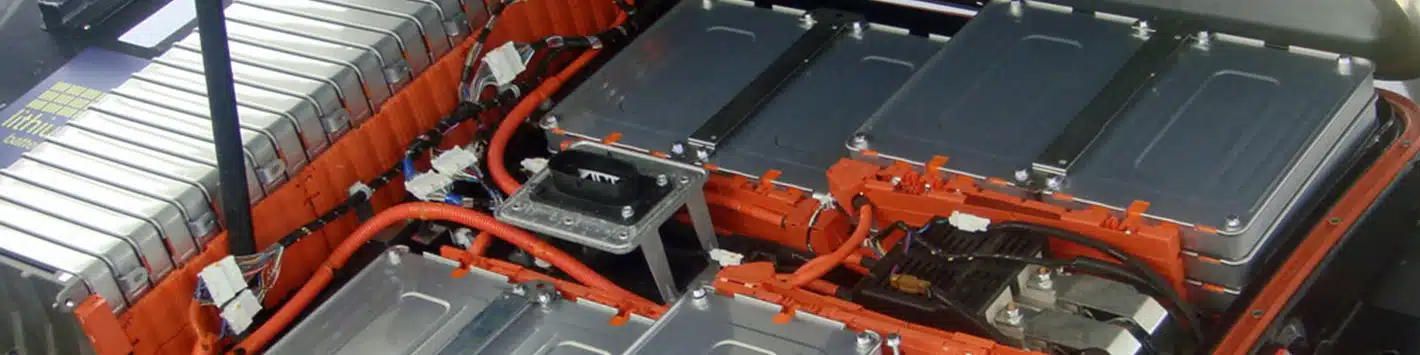
Walk into almost any battery manufacturing facility today and you will find adhesive labels. They are quick to apply, cheap to produce and familiar from decades of product labelling practice. They are also almost certainly non-compliant with Article 13 of Regulation (EU) 2023/1542.
The regulation uses one word to describe what the marking must be: indelible. It does not define the word. It does not need to. Indelible means it cannot be removed. Adhesive labels can be removed. That is the problem, and it is not a minor one.
This article sets out exactly why adhesive labels fail in battery environments, what the regulation actually demands, and what marking technologies genuinely satisfy the requirement.
What the Regulation Actually Requires
Article 13(7) of Regulation (EU) 2023/1542 states that labels and QR codes shall be printed or engraved visibly, legibly and indelibly on the battery. The word appears repeatedly. The carbon footprint label must be indelible. The CE marking must be indelible. The QR code linking to the Battery Passport must be indelible. The separate collection symbol must be indelible.
Two deadlines apply. From 18 August 2026, batteries must carry comprehensive labelling including place of manufacture, battery category, weight and hazardous substance information. From 18 February 2027, all EV and industrial batteries above 2 kWh placed on the EU market must have a digital Battery Passport accessible via a QR code engraved or printed on the battery itself.
The regulation is a performance standard. It does not specify laser marking. It does not ban adhesive labels by name. It sets a standard, indelible, and leaves it to manufacturers and market surveillance authorities to determine whether a given approach meets it.
“Labels and QR codes shall be printed or engraved visibly, legibly and indelibly on the battery.” — Article 13(7), Regulation (EU) 2023/1542
Adhesive labels do not meet it. Here is why.
Four Ways Adhesive Labels Fail in Battery Environments
Thermal Cycling
EV battery packs and industrial batteries operate across wide temperature ranges. Charge and discharge cycles generate heat. Cold starts impose thermal stress. Over time, repeated expansion and contraction weakens adhesive bonds at the interface between label stock and battery casing.
This is not a worst-case scenario. It is normal operating life. A label applied at the point of manufacture may look intact at six months. At three years it may be lifting at the corners. At seven years — which falls well within the intended service life of an EV battery pack — it may be gone.
Chemical Exposure
Battery maintenance involves cleaning agents. Manufacturing environments involve lubricants, solvents and coolants. Many of these attack adhesives directly, degrading the bond between label and substrate long before the battery reaches end of life.
At recycling facilities, batteries are handled in bulk and processed at scale. The chemicals used in battery disassembly and material recovery are not chosen with label preservation in mind. By the point a battery reaches end-of-life processing, any marking that relies on adhesion is at serious risk of being absent entirely.
Mechanical Wear and Handling
EV battery packs are installed, removed and reinstalled during service events. Industrial batteries are charged, moved and handled repeatedly across their working life. Surface abrasion, impact and friction wear away printed ink and degrade label stock. A label that has been scuffed, torn or partially abraded does not meet the legibility requirement, let alone the indelibility requirement.
In automated recycling facilities, batteries are sorted and processed mechanically. A label that cannot survive mechanical handling in service has no realistic chance of surviving end-of-life processing intact.
Service Life
The regulation is explicit that the marking must remain legible throughout the battery’s lifetime. For an EV battery pack, that is a minimum of ten years under typical EU market conditions. For industrial batteries in demanding applications, it can be considerably longer.
An adhesive label is designed to adhere to a surface. It is not designed to form a permanent bond that survives a decade of thermal cycling, chemical exposure and mechanical wear. Those are fundamentally different engineering requirements, and no label manufacturer credibly claims otherwise.
The Compliance Risk Is Not Theoretical
Market surveillance authorities across EU member states have direct enforcement powers under the regulation. Where non-compliance is found, they can require product withdrawal and recall. Incorrect or misleading battery labelling can result in product withdrawals, fines and marketplace delistings.
A label that has peeled away from a battery in a recycling facility is a labelling failure by definition. The marking requirement exists to support traceability across the battery’s entire lifecycle, including at end-of-life. If the label is gone, the traceability chain is broken, and the regulatory purpose of the marking requirement is defeated.
The regulation also applies to all batteries placed on the EU market regardless of where they are manufactured. Chinese, South Korean, Japanese and American producers supplying into Europe face exactly the same requirement as European manufacturers. The compliance burden falls on whoever places the battery on the market.
What Does Pass: Laser Marking and Dot Peen
Laser Marking
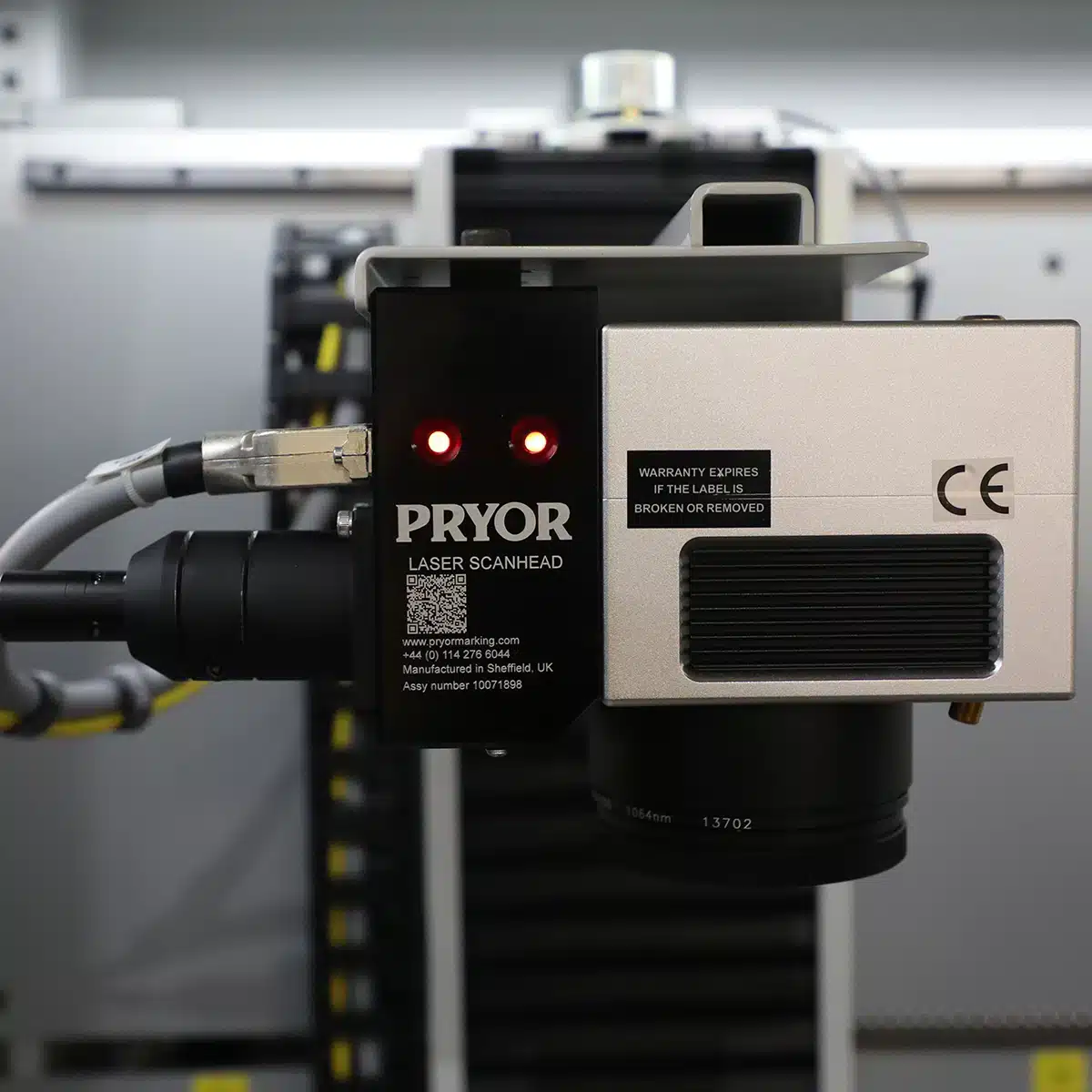
A fibre laser interacts directly with the surface material of the battery casing. The mark is not applied on top of the surface. It is created within the surface itself, through controlled thermal or photochemical change in the substrate material.
There is nothing to peel, nothing to lift and nothing to degrade independently of the casing. A laser-marked identifier on an aluminium battery casing will remain on that casing for as long as the casing exists. It survives the same temperatures, chemicals, vibration and handling that the battery survives. It cannot be separated from the component it identifies without destroying the component.
For EV battery packs and industrial batteries, laser marking also delivers:
- Modern fibre laser systems mark at production line speeds. A data matrix code, serial number, CE mark and carbon footprint classification can all be applied in a single pass, in seconds, without stopping the line.
- QR code quality. Laser-marked QR codes achieve the contrast and resolution required for reliable automated scanning throughout a battery’s lifecycle. A degraded adhesive QR code that cannot be read by automated systems in a recycling facility defeats the entire purpose of the Battery Passport.
- Material compatibility. Fibre laser marking works on aluminium, steel, nickel-plated surfaces and many polymer housings used in battery module construction. MOPA laser systems offer additional control on anodised aluminium and other surface-treated materials.
- Traceability integration. Every laser-marked identifier can be logged at the point of marking, linking the physical battery to its Battery Passport entry immediately.
-
- Audit your current labelling against the indelibility standard. Ask honestly whether the marking will remain visible and legible at end-of-life.
- Assess your battery casing materials. Aluminium, steel and polymer housings all support laser marking. Material type determines which laser source and parameters are required.
- Consider throughput requirements. A laser marking system needs to integrate into your production line without creating a bottleneck. Modern fibre lasers mark at speeds compatible with high-volume EV battery assembly.
- Plan for Battery Passport integration. The QR code is the physical access point for the digital passport. Its quality and permanence directly affects the reliability of your traceability chain.
Dot Peen Marking
Dot peen marking uses a carbide or diamond-tipped stylus to displace material and create a series of micro-indentations in the surface. Like laser marking, it creates a permanent change in the substrate rather than applying anything to the surface.
Dot peen is particularly suited to thicker-walled battery casings and applications where a tactile, deeply indented mark is required. It is a proven technology in high-volume automotive marking and is fully capable of meeting the indelibility standard the regulation demands.
Both technologies produce marks that are genuinely indelible. Neither relies on adhesion. Both have decades of proven performance in demanding industrial environments.
A Note on the Packaging Fallback
The regulation does include a provision for situations where marking directly on the battery is not possible or not warranted due to the nature and size of the battery. For such cases, the label may be affixed to the packaging or included in the accompanying documentation.
This fallback exists for small batteries, button cells and cylindrical cells below a certain size where the physical surface area makes direct marking technically impractical. For EV battery packs and industrial batteries above 2 kWh, that argument is not available. These are large components with substantial casing surface area. The packaging fallback does not apply. The marking must be on the battery. It must be indelible.
What to Do Before the Deadlines
The August 2026 labelling deadline is approaching fast. The February 2027 QR code and Battery Passport deadline follows closely behind. Neither allows a wait-and-see approach.
If your current process uses adhesive labels, the practical steps are:
We have been building laser and dot peen marking systems in Sheffield for longer than most battery manufacturers have existed. Our engineers understand what these applications demand. If you are working through what compliance looks like for your production process, speak to us. We have probably seen your exact challenge before.
Speak to our team
Speak to our engineers about battery marking compliance: info@pryormarking.com | +44 114 276 6044