
What is MOPA laser marking, and when do you actually need it?
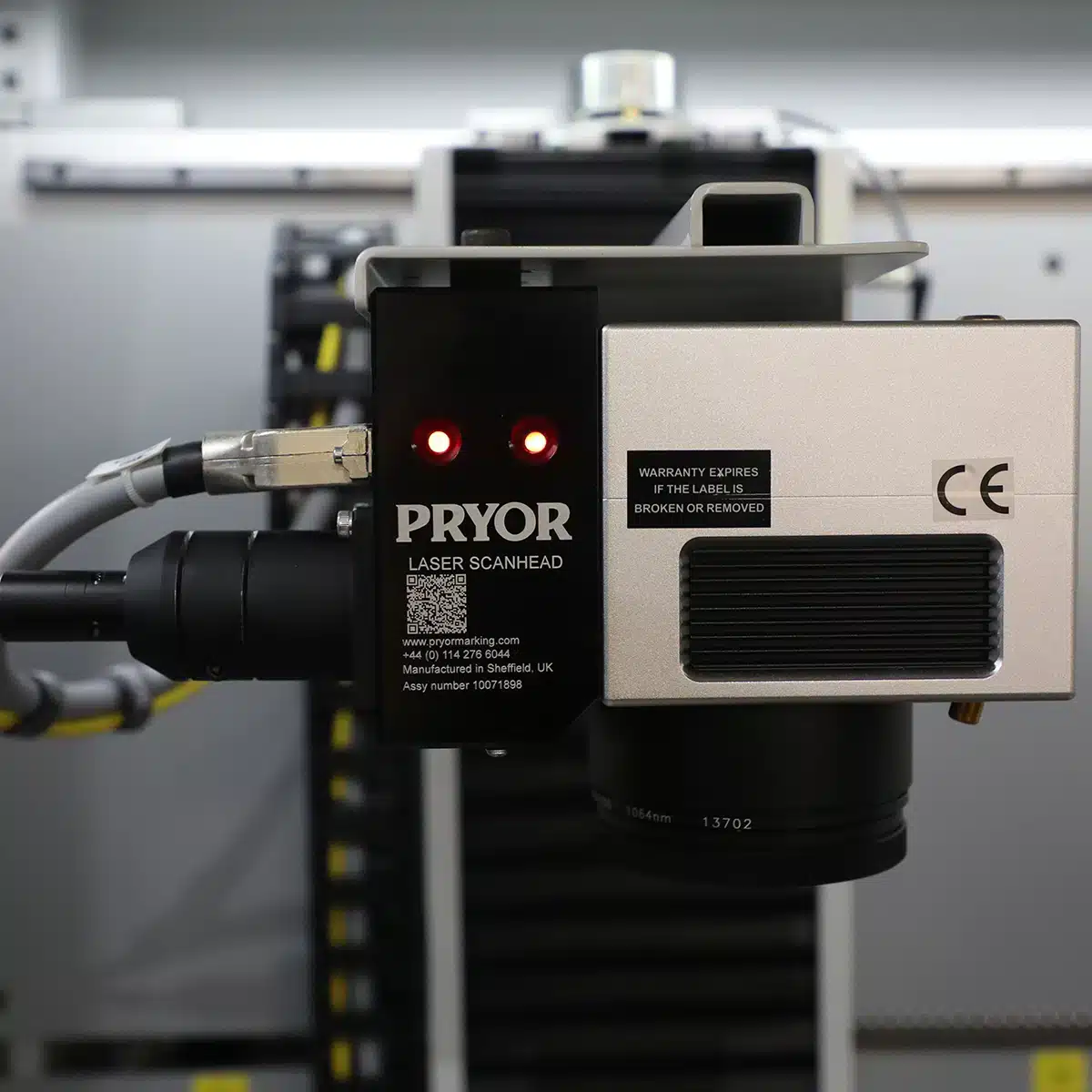 Quick answer: A MOPA (Master Oscillator Power Amplifier) laser is a fibre laser with adjustable pulse width, typically tunable from 4 ns to 200 ns and frequencies up to 1 MHz. That single capability unlocks four results a standard fibre laser cannot reliably produce: colour marking on stainless steel and titanium, deep black marking on anodised aluminium, clean high-contrast marking on plastics without burning, and faster cycle times on deep engraving. If your parts include any of those materials, MOPA is the right specification. For straightforward serialisation on steel, a standard fibre laser remains the more cost-effective choice.
If you’ve been specifying fibre laser marking machines recently, you’ll have come across the term MOPA. It appears on product datasheets, it comes up in application discussions, and it’s the reason some marking demonstrations produce results that a standard fibre laser simply can’t match.
But what does it actually mean? And, more to the point, does your application need it, or will a standard fibre laser do the job just as well at lower cost?
This is a question we get asked regularly. The honest answer is: it depends on what you are marking and what result you need. We now offer MOPA fibre source as a configurable option across almost all of our laser marking machines, which gives our customers far more flexibility than they had previously. Here is a straightforward explanation of the technology, what it changes in practice, and how to decide whether it’s relevant to your production line.
What does MOPA stand for?
MOPA stands for Master Oscillator Power Amplifier. The name describes the architecture of the laser source: a master oscillator generates the initial laser signal, and a separate power amplifier boosts that signal to the required output level.
That two-stage structure is what makes MOPA different from a conventional fibre laser. In a standard fibre laser, the pulse characteristics, particularly pulse duration, are largely fixed by the source design. You can adjust power, frequency, and speed, but the pulse width stays within a narrow range, typically around 100 to 120 nanoseconds.
In a MOPA fibre laser, pulse duration becomes an independent variable. You can adjust it across a wide range, typically 4 ns to 200 ns, without changing output power or frequency. Pulse repetition frequency can also be set far higher than on a Q-switched source, often up to 1 MHz against a Q-switched ceiling of around 100 kHz. That combination of independent pulse width and high-frequency control is what opens up a range of marking results that are simply not achievable with a conventional fibre laser.
What does adjustable pulse width actually change?
Pulse width controls how long the laser energy is in contact with the material surface in each individual burst. Shorter pulses concentrate energy over a very brief period, creating a cold, precise interaction. Longer pulses spread energy over more time, generating more heat in the material.
In practice, this matters because different marking processes require different thermal conditions:
- Colour formation on stainless steel through laser annealing requires precisely controlled, low heat input. Too much heat produces the wrong colour, or no colour at all.
- Black marking on anodised aluminium depends on ablating the anodised layer cleanly without melting the underlying metal.
- High-contrast marking on plastics requires enough energy to create a visible mark without burning, foaming, or deforming the surface.
- Deep engraving on hard metals benefits from very short, high-peak-power pulses that remove material efficiently without excessive heat build-up in the surrounding area.
A standard fibre laser, with its fixed pulse width, is a good general-purpose tool. A MOPA fibre laser is a precision instrument. The same physical machine can be configured to mark across all of these modes, simply by adjusting pulse duration in the software.
What can a MOPA laser do that a standard fibre laser cannot?
Colour marking on stainless steel and titanium
This is the capability that tends to generate the most interest, and for good reason. A MOPA laser can produce stable, repeatable colours on stainless steel and titanium, ranging from gold and bronze through blue, purple, and dark green, by inducing controlled surface oxidation through laser annealing.
The colour produced depends on the thickness of a transparent oxide layer formed on the surface, and that thickness is controlled by adjusting pulse parameters. The physics is thin-film interference: part of the incident light reflects from the top of the oxide layer, part reflects from the metal beneath, and the interaction of those reflected waves produces a specific visible colour under light. Short pulses at the right frequency produce a thin oxide layer that corresponds to a specific, repeatable colour. The process removes no material, which means surface dimensions and mechanical properties are unchanged.
A standard fibre laser cannot reliably achieve this. The fixed pulse width doesn’t give sufficient control over thermal input, and colour results are inconsistent. For manufacturers producing medical instruments, surgical tools, or aerospace components where colour-coded identification is required, the difference is significant.
The annealing process for colour marking leaves no raised edges, no material removal, and no change to surface finish beyond the mark itself. This matters for applications where dimensional tolerances are tight, with aerospace fasteners and surgical instruments being obvious examples. The mark also passes through autoclaving and surface sterilisation cycles without degrading, which is essential for reusable medical devices.
Deep black marking on anodised aluminium
Anodised aluminium is one of the most common materials in consumer electronics, aerospace, and automotive trim. It takes a laser mark well, but getting consistent, deep black marks without damaging the underlying substrate requires short, controlled pulses.
A MOPA laser operating with short pulse durations (typically 4 to 20 ns) can ablate the anodised layer to produce a high-contrast black mark with clean edges. The mark is permanent and survives in service conditions that would remove a label or an inkjet-applied code.
Standard fibre lasers can mark anodised aluminium, but the marks tend to be lighter in contrast and less consistent across varying anodise thicknesses. For consumer electronics enclosures or automotive interior trim, where mark appearance matters as much as readability, MOPA is the better choice.
High-contrast marking on plastics without burning
Plastics present a specific challenge for laser marking. The material is thermally sensitive: push too much energy in and the surface melts, foams, or discolours unpredictably. Too little energy and the mark is weak or invisible.
MOPA adjustable pulse width allows laser parameters to be tuned precisely to the plastic being marked, whether that is polycarbonate (PC), ABS, polyamide (PA / nylon), or PBT. Short pulses reduce heat transfer to the surrounding material, creating a clean mark with good contrast and no surface damage.
This is particularly useful for traceability codes on medical device packaging and electronics housings, and for day and night marking on automotive interior components.
Day and night marking on automotive components
Day and night marking is a specific automotive application that is almost exclusively a MOPA process. The technique involves laser-ablating a paint or coating layer from a backlit component (think dashboard switches, climate control panels, infotainment buttons) to reveal a translucent substrate beneath. The result: a clean opaque legend by day, an illuminated legend by night.
The challenge is removing the paint cleanly without burning, scarring, or perforating the substrate underneath. That requires precise heat control. Standard Q-switched fibre lasers tend to leave inconsistent edges and can damage the underlying plastic. MOPA, with its tunable short pulses, achieves the clean ablation that automotive OEMs specify.
Faster cycle times on deep engraving
For applications requiring deep marks, such as permanent serial numbers on engine blocks, depth marks on tooling, or marks intended to survive significant surface wear, higher peak power pulses remove material more efficiently.
A MOPA laser at short pulse widths can achieve higher peak power for the same average power as a standard fibre laser. That translates to faster material removal per pass, which matters when you’re running high volumes of parts through a production line. The time saving compounds quickly across a shift.
MOPA fibre laser vs standard fibre laser: key differences
| Feature | Standard fibre laser | MOPA fibre laser |
| Pulse width | Fixed (~100 to 120 ns) | Adjustable (4 to 200 ns) |
| Pulse frequency | Up to ~100 kHz | Up to 1 MHz |
| Colour marking on stainless steel | Unreliable / inconsistent | Stable and repeatable |
| Black on anodised aluminium | Light contrast | Deep, high-contrast black |
| Plastic marking quality | Can burn or foam | Clean, controlled |
| Day and night marking | Not suitable | Application of choice |
| Deep engraving speed | Standard | Faster at equivalent power |
| Cost (relative) | Lower | Higher (typically 20 to 30%) |
| Typical applications | Metal traceability, serial numbers, Data Matrix codes | Colour ID, electronics, medical UDI, automotive trim, plastics |
When is a standard fibre laser still the better choice?
It’s worth being direct about this: not every application needs MOPA capability.
If you are marking stainless steel with alphanumeric serial numbers in a single colour, black or grey, a standard fibre laser does this reliably and well. If you are marking Data Matrix codes on mild steel or tool steel for traceability, the additional capability of MOPA is largely wasted.
Standard fibre lasers are typically lower in cost than MOPA equivalents at the same power level. If your application doesn’t require colour output, very high contrast on plastics, or deep black on anodised aluminium, there is no compelling reason to pay for the additional capability.
The best way to decide is to assess your material and required output first:
- Stainless steel, alphanumeric or 2D code, black or grey mark: standard fibre is fine.
- Stainless steel with colour output required: MOPA needed.
- Anodised aluminium, high-contrast black mark: MOPA preferred.
- Tool steel or mild steel, deep Data Matrix for traceability: standard fibre is fine.
- Plastics, high-contrast marking without burning: MOPA preferred.
- Titanium for aerospace or medical, anneal-based marking: MOPA preferred.
- Automotive day and night marking on backlit components: MOPA required.
If you’re unsure which applies to your parts, we’re happy to run samples on both. The difference is visible immediately.
Which industries use MOPA laser marking?
MOPA capability tends to be most valued in sectors where marking appearance, material sensitivity, or compliance with specific output standards drives the specification.
Medical devices
UDI (Unique Device Identification) requirements under EU MDR and IVDR, and the equivalent FDA UDI rules, require permanent, high-contrast marks on surgical instruments and implants, including titanium and cobalt-chrome components. MOPA delivers clean annealing marks on these materials without material removal, which matters when surfaces have been precision-ground or are dimensionally critical, and when the device must survive hundreds of autoclave cycles.
Automotive
Day and night marking on interior components, black marking on anodised trim, and high-contrast 2D codes on plastic housings are all MOPA applications. Automotive manufacturers also use MOPA for marking on coated parts where a standard laser would burn the coating inconsistently. VIN label marking is another area where MOPA delivers the clean, repeatable contrast that OEMs increasingly specify.
Aerospace
Colour-coded marking on fasteners and structural components is one application. More broadly, MOPA’s low thermal input makes it suitable for marking on heat-sensitive aerospace alloys, where conventional fibre lasers risk affecting material properties in the heat-affected zone. AS9132-compliant Data Matrix marks are achievable, with verification handled through integrated vision.
Electronics and semiconductors
Marking on PCBs, chip carriers, and electronic enclosures requires precision and minimal thermal stress. MOPA’s short pulse capability makes it suitable for components where a conventional laser would damage adjacent circuitry or sensitive materials.
General industrial
Any application requiring high-contrast marks on anodised parts, or marking across a mixed material base that includes both metals and plastics, benefits from the flexibility MOPA provides from a single machine. For manufacturers running varied product mixes through a single marking station, that flexibility removes the need for multiple systems.
What to ask when specifying a MOPA laser system
Once you’ve established that MOPA capability is relevant to your application, the specification question shifts to the system around the laser source. The pulse parameters are only part of the story. For industrial production use, the factors that matter most in practice are:
- How is pulse width set and adjusted: manually per job, or programmed per part type within the software?
- What software integration does the system support: can it connect to your MES, read from a database, and push marking data downstream?
- What is the beam quality at the working distance you need, and does the focus hold across your part geometry?
- If you’re marking 2D codes, is there an integrated vision verification system, and can it grade to ISO 15415 and ISO/IEC TR 29158 DPM standards?
- What UK-based service and support is available: for an industrial production system, response time matters as much as hardware specification.
- Can the same enclosure or integrator format be used if you later move from MOPA to standard fibre, or vice versa?
MOPA laser marking at Pryor
We’ve been making marks on metal since 1849. MOPA fibre source is now available as a configurable option on all of our laser marking machines, including portable, benchtop, workstation, and OEM integrator systems. Whether you’re specifying a compact MarkMate Laser for a workshop, a Workstation Laser for a production cell, or an integrator laser to be built into a fully automated line, MOPA capability is available in the same enclosure format you’d otherwise specify.
For applications requiring portability, our Pryor Portable Laser, the first battery-powered Class 1 certified portable laser marker on the market, runs a 30W pulsed fibre source and is well suited to marking on large assemblies and structural components in the field.
If you’re unsure whether your application needs MOPA capability specifically, or whether a standard fibre laser would serve you just as well, send us your samples first. We run application testing in Sheffield and can give you a clear recommendation based on your actual parts, not a theoretical spec comparison.
Speak to our Team
Speak to our engineers about your application. Call us on +44 (0)114 276 6044 or visit machines.pryormarking.com.
Frequently asked questions about MOPA Lasers
Is a MOPA laser the same as a fibre laser?
Yes, a MOPA laser is a type of fibre laser. Both generate the laser beam within an ytterbium-doped optical fibre. The difference is in the architecture: a MOPA source uses a master oscillator and separate power amplifier, which allows pulse duration to be adjusted independently of power and frequency. A standard Q-switched fibre laser has a fixed pulse width set by the source design.
Can a standard fibre laser produce colour marks on stainless steel?
Not reliably. Some colour effect is sometimes achievable with a standard fibre laser, but results are inconsistent and not repeatable across batches. Producing stable, reproducible colour marks on stainless steel requires the fine pulse width control of a MOPA source.
How much more does a MOPA fibre laser cost than a standard fibre laser?
MOPA fibre laser sources typically add around 20 to 30% to the cost of an otherwise equivalent system, though the exact difference depends on power rating and machine specification. The question to ask is not whether MOPA is more expensive, but whether the applications it enables, colour, anodised black, clean plastic marking, justify the difference for your production.
What materials can a MOPA laser mark?
MOPA fibre lasers mark all the materials a standard fibre laser handles (stainless steel, mild steel, tool steel, brass, copper, anodised aluminium, titanium, most engineering alloys) and additionally produce significantly better results on plastics (PA, PBT, ABS, PC, PET) and on anodised or coated surfaces. They are not appropriate for organic materials such as wood, paper, leather, or rubber, which require a CO2 laser.
Is MOPA the same as a Q-switched laser?
No. A Q-switched fibre laser uses a Q-switch to generate short, high-energy pulses with a fixed pulse width. A MOPA laser uses a separate master oscillator and power amplifier, which decouples pulse generation from amplification and allows pulse width to be tuned independently. Both produce nanosecond-range pulses, but only MOPA gives the operator control over pulse duration as an independent variable.
Can MOPA lasers do deep engraving?
Yes. At short pulse widths, MOPA lasers achieve higher peak power for a given average power, which enables faster material removal than a standard fibre laser of equivalent rating. For deep engraving on hardened steels or thick stainless components, this can deliver meaningful cycle time reductions.