
Introducing the New Pryor Integator Laser
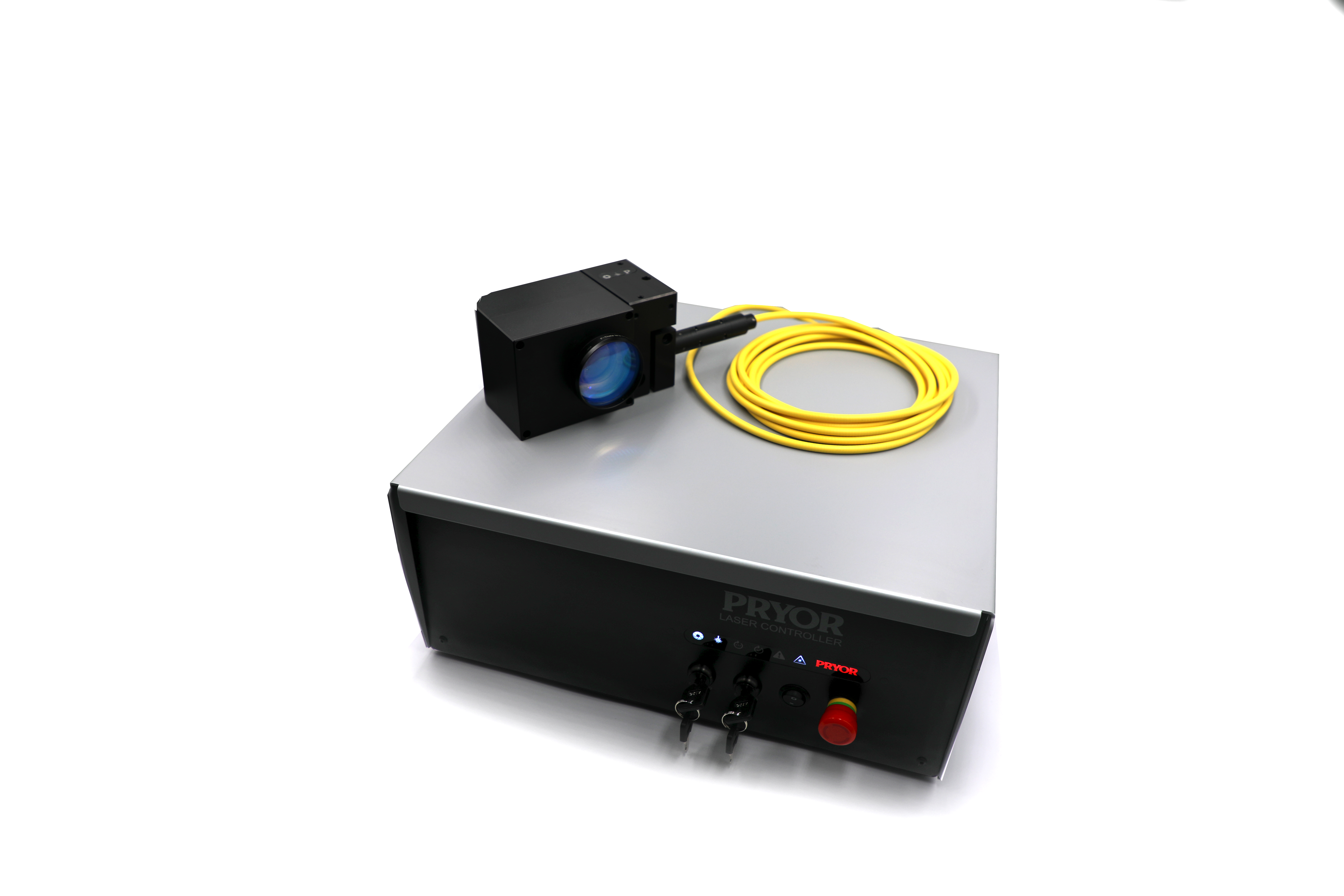 Your PLC. Your Network. Our Integrator Laser
The hardest part of integrating a marking system into an automated production line has never been the marking itself. It’s been the conversation between the laser and everything else.
How does the laser know what to mark? How does the PLC know when marking is complete? How does your MES push a serial number into the job without someone typing it in? These are the questions that turn a straightforward laser installation into a weeks-long integration project, and they’re the questions that Pryor’s new communications architecture is designed to answer.
The new Integrator laser marker platform doesn’t just offer more interfaces. It offers the right interfaces, matched to the protocols that industrial automation engineers actually use in 2026. So, what’s changed?
Two Modes. One Platform. Total Flexibility.
Every Pryor laser marker operates in one of two fundamental modes: embedded/standalone, where the laser runs autonomously from its own onboard controller, or PC-controlled, where Pryor’s traceability software drives the system from a connected host computer.
The clever part is that both modes are fully supported, and both have been significantly upgraded. Whether your architecture puts a PC at the heart of the cell or demands a PLC-first approach with no PC in sight, the laser has a native communication path ready for you.
| Whether your architecture demands a PLC-first approach or a PC-driven system, there’s a native communication path ready — no middleware, no custom adaptors. |
Native Fieldbus. No Middleware Required.
For integrators building PLC-first architectures, the new optional fieldbus modules are the headline feature. Plug in the appropriate Anybus module and the laser controller appears on your network as a first-class fieldbus device, ready to receive layout commands, variable data, and start triggers directly from your PLC programme.
| OPTIONAL MODULE X11
EtherNet/IP For Rockwell / Allen-Bradley environments. Control layout selection, insert variable data, and trigger marking cycles directly from your ControlLogix or CompactLogix PLC, no PC, no custom software. |
OPTIONAL MODULE X11
PROFINET For Siemens TIA Portal environments. The laser appears as a standard PROFINET device. Commission it exactly as you would any other IO device on the network. |
| STANDARD X5
Ethernet TCP/IP Socket Open TCP/IP socket interface for custom PC-based applications, MES systems, or any software that can open a socket connection. No proprietary APIs required. |
STANDARD X9
RS-232 Serial For legacy PLCs or simple trigger applications where you need maximum compatibility. Load layouts, insert variables, and start marks over a standard serial connection. |
Integrator Advantage
| No translation layer. No custom code.
With native EtherNet/IP and PROFINET support, the laser fits directly into your PLC project using standard function blocks. Your commissioning engineer works in the same tool, with the same approach, as every other device on the line. |
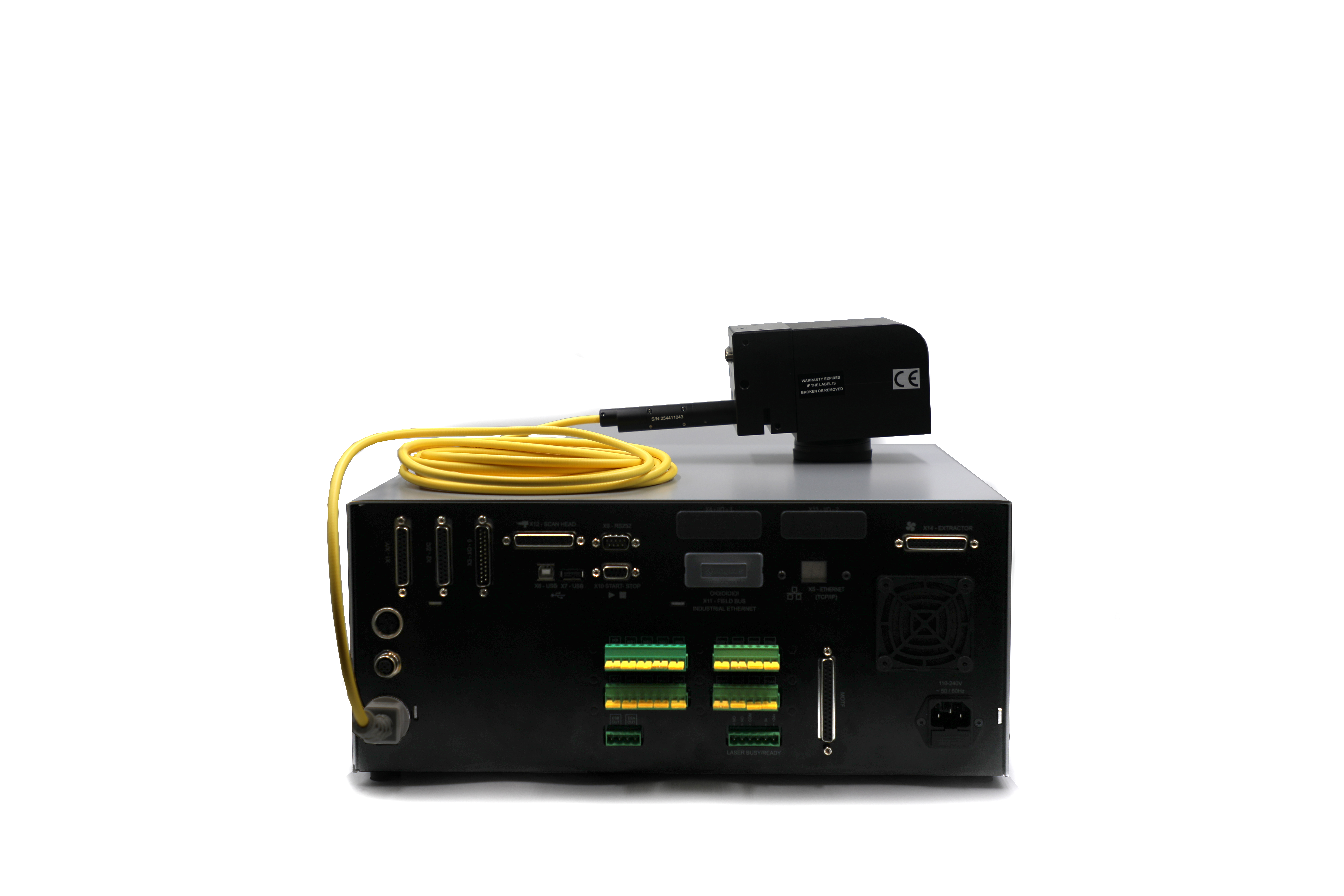
Signals That Scale With Your System.
The standard Digital I/O (X3) gives you 8 inputs and 6 outputs (24 V). Add optional expansion modules on X4 and X13 and that scales to 24 inputs and 18 outputs, more than enough for complex multi-station cell architectures without an external I/O module.
A dedicated Start/Stop input (X10) gives you a clean discrete trigger interface wired direct from a PLC output or a physical push-button. And the Laser Busy/Ready volt-free relay gives the rest of your line a hardware-level signal to confirm when the marking cycle is complete, no polling, no protocol, just a contact closure your PLC can read directly.
The One That Changes the Conversation: OPC-UA.
If you’re building a PC-controlled cell using Pryor’s MarkMaster 4 software, the standout new capability is OPC-UA – Open Platform Communications Unified Architecture. A vendor-neutral, IEC 62541-standardised protocol supported natively by every major PLC manufacturer.
Previous interfaces essentially gave you a command channel: send a command, trigger a mark. OPC-UA goes further. MarkMaster 4’s implementation supports bidirectional data exchange. Your automation system can send variable data to the laser and read variable data back from the active layout, enabling real-time traceability confirmation, inline data verification, and tighter integration with MES and WMS systems.
| OPC-UA doesn’t just let your PLC talk to the laser — it lets the laser talk back. That’s the difference between a trigger signal and a traceable data loop. |
| Interface | Software | Direction | Best for | |
| OPC-UA | MarkMaster 4 | Bidirectional | Multi-brand PLC environments, MES integration, traceability data loops | ● New |
| EtherNet/IP | Embedded | Cmd + trigger | Rockwell / Allen-Bradley PLC cells, no PC required | ● New |
| PROFINET | Embedded | Cmd + trigger | Siemens PLC cells, no PC required | ● New |
| TCP/IP Socket | Embedded / MM2 | Cmd + trigger | Custom software, MES/WMS integration, open-protocol environments | ● Std |
| RS-232 | Embedded / MM2 | Cmd + trigger | Legacy PLCs, simple integrations, maximum compatibility | ● Std |
| Digital I/O | All | 24V HW signals | Sensors, clamps, feed systems, discrete trigger/status | ● Std |
Built for the Machine, Not Bolted On.
The controller supports up to four dual-channel emergency stop inputs, allowing the laser to be incorporated directly into a machine’s category 3 or PLd E-Stop chain. Complementary E-Stop monitoring outputs provide dual-channel volt-free feedback contacts so a higher-level safety PLC can monitor the laser’s entire E-Stop circuit — including the front-panel button — without any additional hardware.
This is the kind of architecture that passes a CE machinery assessment rather than creating headaches for it. The result is a laser marker that earns its place in a modern automated cell, not as a special case that needs special treatment, but as a proper industrial device that integrates cleanly and confidently.
For systems integrators, that means less time writing custom communication layers and more time on the things that actually differentiate your solution. For end users, it means a laser that talks to their existing infrastructure on day one, and scales with it as that infrastructure evolves.
Pryor’s engineering team is available to discuss integration requirements at the design stage — whether you’re specifying a new cell, retrofitting into an existing line, or evaluating protocol options for a multi-site rollout. Pryor offers a full bespoke custom solutions division.
Let’s Talk Integration.
Specify your PLC environment, automation architecture, or software stack and our technical sales team will confirm the right communication configuration for your application. Call us today on +44 114 276 6044 or Contact our team today