
How Safe Is a Portable Laser Marking Machine?
Portable laser markers solve a problem that has frustrated manufacturers for years. What do you do when the part is too big, too heavy or too awkward to bring to a machine? Instead of lifting a casting, a chassis or a length of pipe onto a benchtop system, you bring the 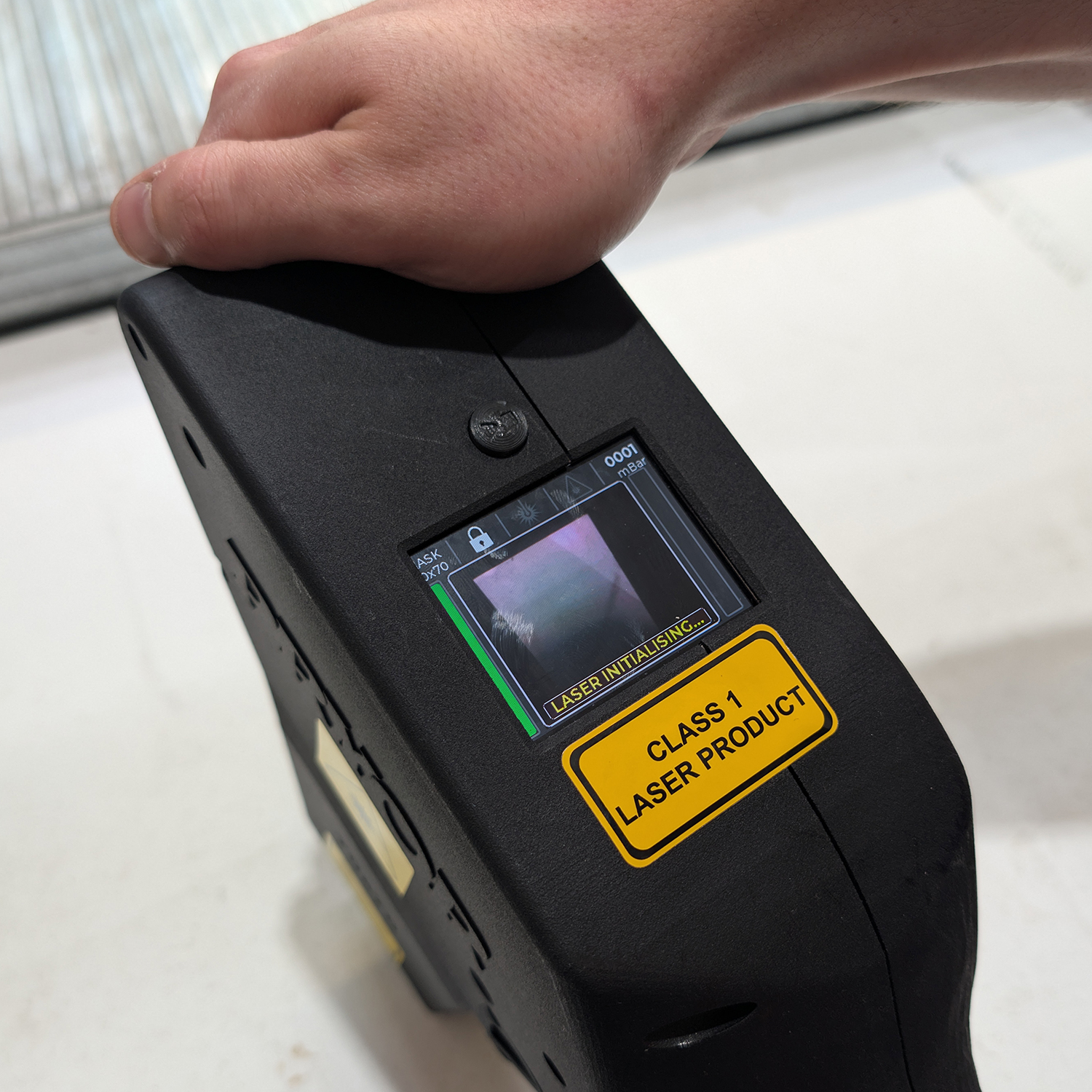 laser to the workpiece. It’s a genuinely useful piece of kit.
But it raises an obvious question, and it’s one we’re asked all the time. If you’re holding a laser in your hand and pointing it at a part, how safe is that really?
It’s a fair question, and the honest answer starts with a fact that surprises people.
Yes, it is a powerful laser
The fibre laser source inside a portable marking system is a Class 4 laser, the highest hazard classification there is. On its own, an exposed Class 4 beam can cause serious eye and skin injury, and that’s true of the laser inside almost any industrial marker, portable or not.
So how can it be safe to hold one against a workpiece by hand?
You’re never actually exposed to that Class 4 beam. The machine is engineered so that, in normal use and under foreseeable fault conditions, no hazardous laser radiation can reach the operator. In safety terms, a Class 4 source is built into a Class 1 system, the same category as the laser in a supermarket barcode scanner. The power is real, but the exposure is designed out.
That’s the whole game with portable laser safety. It isn’t about a weaker laser. It’s about a smarter system around it.
How a Class 4 laser becomes a Class 1 system
Three things work together, and the clever part is that the laser won’t fire unless all three agree.
The contact shroud. The marking head sits inside a shroud, a mechanical enclosure that surrounds the marking zone and presses against the workpiece. It contains the beam and controls reflected radiation so that nothing escapes the marking area. Shrouds are interchangeable, so you can fit a full-area version for flat surfaces or a narrower one for cylindrical parts such as tubes.
A seal check. A fan creates a pressure condition inside the shroud, and a differential pressure sensor monitors it. If the shroud is correctly seated against the part, the seal is good and the sensor confirms it. If the shroud is missing, damaged or lifted away, the seal fails, and so does the check.
An independent contact check. Separately, a force or contact sensor confirms that the head is physically seated against the workpiece. This is a deliberately independent channel, not a second opinion from the same sensor.
Only when both the seal and the contact are confirmed will the safety controller allow the laser enable chain to become active.
Why pulling the trigger isn’t enough
This is the point worth dwelling on, because it’s the heart of how these machines are made safe.
On a portable marker, the operator’s trigger is a request, not a command. Pressing it doesn’t fire the laser. The request is routed through a safety controller, which will only permit emission once the pressure channel and the contact channel both confirm the head is correctly positioned. Pull the trigger in mid-air and nothing happens. The laser simply cannot emit unless it’s sealed against a part the way it’s meant to be.
That single design decision, where the trigger alone cannot enable emission, is what allows a hand-held device to carry the most powerful class of laser and still be safe to use.
What happens when something goes wrong
A safety system is only as good as its behaviour on a bad day, so portable markers are built to fail safe. The principle is simple: anything unexpected results in no emission, never continued operation.
Lift the head and lose contact, and emission stops immediately. Lose the shroud seal, and emission stops. Whether it’s a sensor fault, a damaged cable, a power cut or an emergency stop press, every one of these drops the laser enable and puts the machine into a safe state. After a power interruption it won’t spring back to life on its own either. Restart requires a deliberate, valid sequence, so there’s no surprise emission when the power returns.
The standards behind it
None of this is decided by a manufacturer in isolation. Portable laser markers are assessed against recognised safety standards, and the key one is EN ISO 11553-2, which deals specifically with hand-held and hand-operated laser processing devices. That’s exactly this kind of machine. It sits alongside EN ISO 11553-1 for laser processing machines generally and EN 60825-1 for laser classification and labelling.
Behind those are the standards that govern how the safety functions themselves are designed and proven: EN ISO 12100 for risk assessment, EN ISO 13849 for safety-related control systems, EN 60204-1 for electrical safety, and the relevant EMC standards. We treat the laser-inhibit function as a safety-related control function and validate it as such, with the supporting risk assessment, test reports and Declaration of Conformity held in the technical file.
Safety isn’t only about the beam
A good safety assessment looks past the obvious hazard too. Reflected radiation is controlled by the shroud geometry and a controlled working distance. Marking can produce fume and fine particulate, so our instructions call for suitable extraction and ventilation. We verify electrical safety through protective bonding, insulation and leakage testing. And freshly marked parts can be hot, so we flag that in the user information as well.
The operator’s part
Engineering controls do the heavy lifting, but a portable laser is still an industrial tool. The residual risk to an operator is negligible during intended use when the instructions are followed. That means using the right shroud for the job, keeping it in good condition, reading the safety labels, wearing any specified PPE and not attempting to defeat the safeguards. Designed-in safety and sensible use go hand in hand.
The bottom line
So, how safe is a portable laser marking machine? Safe enough to hand-hold against a workpiece all day, not because the laser is weak, but because the system around it is built so that hazardous emission simply cannot reach you in normal use or when a fault occurs. The Class 4 power stays sealed inside a Class 1 system.
If you’re weighing up portable marking for large or awkward components and want to talk through the safety side in detail, we’re always happy to help. Call us on +44 (0)114 276 6044 or get in touch through the website.