
QR Code vs Data Matrix: Which One for Industrial Marking?

What each one is built for
QR codes were designed for quick, human-facing access to information. Point a smartphone camera at one and it opens a link, a document or a contact card in seconds. That’s what they’re good at: bridging a physical object to digital content for a person holding a phone.
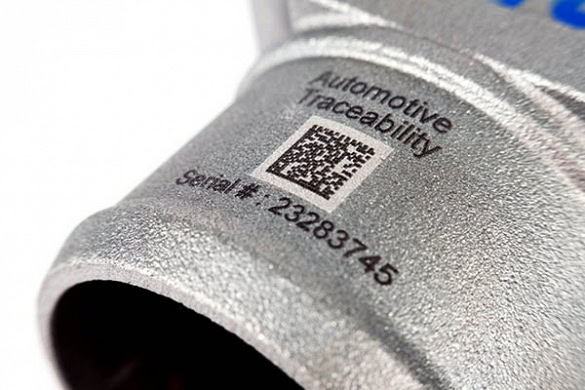
Data Matrix codes were built for a different job entirely: dense, compact, machine-read identification directly on a part. They’re read by fixed industrial cameras and scanners, not phones, and they’re designed to survive being marked directly onto metal, plastic or composite surfaces rather than printed on a label.
That difference in intended reader, a person’s phone versus a production-line scanner, is what should drive your choice more than anything else.
Data capacity, precisely
- QR code: up to 7,089 numeric-only characters, or up to 4,296 alphanumeric characters, at the largest symbol size (Version 40) with the lowest error correction level. Most real-world QR codes, which mix letters and numbers, sit well under the 4,296 figure rather than the higher numeric-only maximum.
- Data Matrix: up to 3,116 numeric digits, or up to 2,335 alphanumeric characters, in a single symbol.
On paper, QR codes can hold more. In practice, neither figure matters much for industrial part marking, where you’re usually encoding a part number, batch, serial number and date, well within both codes’ capacity. The deciding factor is almost never how much data you need to fit. It’s how and where the code gets read.
Durability: how much damage can each one take
Data Matrix codes built to the ECC200 standard use Reed-Solomon error correction, which allows the symbol to remain readable even with a meaningful portion of it damaged, worn or obscured. Published technical descriptions of ECC200 put that tolerance at roughly a quarter of the code. That matters on a factory floor, where a mark might pick up scratches, grease or corrosion over its working life.
QR codes also carry error correction, but they’re more commonly printed on labels or packaging than marked directly onto metal parts in harsh environments. If you’re marking a component that has to survive years on a production line, in a vehicle, or in the field, Data Matrix is the format built and proven for that use case.
Verifying quality: ISO/IEC 29158
A code is only useful if it actually scans, every time, at every stage of the supply chain. That’s what ISO/IEC 29158 is for. It’s the standard specifically written for grading direct part mark Data Matrix codes, the ones marked straight onto a component rather than printed on a label, and it sets out how to measure and verify mark quality objectively. It grew out of an earlier industry guideline known as AIM-DPM and is now the reference standard our own verification processes are built against.
This is one of the practical reasons Data Matrix dominates industrial part marking over QR: there’s a mature, recognised standard for proving the mark you’ve made is actually good enough to read reliably, throughout the life of the part.
Where each one gets used
Automotive: Data Matrix codes laser marked directly onto individual components give production lines part-level traceability from raw material through to the finished vehicle.
Pharmaceutical: Data Matrix codes on packaging support anti-counterfeiting and batch traceability, which is why they’re now standard across much of the pharmaceutical supply chain.
Electronics: Data Matrix identifies circuit boards and components that need to stay traceable even after exposure to heat during soldering or assembly.
Customer and technician-facing content: QR codes work well alongside these applications, printed on a data plate or packaging to give a customer or maintenance engineer quick access to a manual, a warranty registration or a service history. Increasingly we see both used together: a Data Matrix code for the machine-read production record, a QR code nearby for the human-read documentation.
Which one do you need?
If the priority is reliable, permanent, machine-read traceability on the part itself, in an industrial environment, choose Data Matrix. If the priority is giving a person quick access to information from their phone, a QR code does that better. Plenty of manufacturers use both, just for different jobs on the same product.
How we mark 2D codes onto parts
We design and build our dot peen and laser marking machines here in Sheffield, and Data Matrix is the code we mark onto industrial parts most often, for exactly the durability and verification reasons above.
Dot peen marking strikes the surface with a series of precisely controlled pins, leaving a raised, permanent Data Matrix code that holds up to wear, corrosion and rough handling. See our dot peen marking machines.
Laser marking etches or engraves the code directly into the surface, giving a high-contrast, permanent result across a wide range of materials. See our laser marking machines.
If you’re weighing up QR against Data Matrix for a specific part or application, speak to our engineers. Call us on +44 (0)114 276 6044, email info@pryormarking.com, or get in touch through the website.