
Laser Safety Classifications Explained
What Every Manufacturer Needs to Know
Walk into any manufacturing environment and the chances are there’s a laser somewhere on the floor. Laser marking has become the default choice for permanent part identification across aerospace, automotive, medical, and heavy industry – and the technology continues to advance quickly.
But there’s a question that comes up regularly when manufacturers are specifying or purchasing laser marking equipment: what do the laser safety classes actually mean, and does it matter which one a machine falls into?
It matters quite a lot. The classification of a laser system determines the safety controls it requires, the training your operators need, and how the machine integrates into your production environment. For manufacturers evaluating laser marking equipment, understanding the classification system is not just a regulatory formality – it’s a practical buying consideration.
Here’s a plain-English guide to how laser classification works, what each class means in practice, and why Pryor’s laser marking machines are designed and built to operate as Class 1 systems.
The Standard: IEC 60825-1
Laser safety classification in the UK and internationally is governed by IEC 60825-1, published by the International Electrotechnical Commission. This standard defines seven laser classes – Class 1, 1M, 2, 2M, 3R, 3B, and 4 – based on the potential for a laser to cause biological harm to the eyes and skin.
Classification takes into account the accessible emission level (AEL), which considers the laser’s output power or energy, its wavelength, the duration of exposure, and the physical characteristics of the beam. The higher the class number, the greater the potential hazard.
All laser products sold in the UK and EU must be labelled with their class in accordance with IEC 60825-1. The standard is also referenced in BS EN 60825-1, the British and European adoption. In the United States, the equivalent is ANSI Z136.1, though from 2007 the two systems have largely converged.
The table below gives a quick summary of all seven classes before we look at each in more detail.
Laser Classification Summary
| Laser class | Hazard level | Key characteristic | Typical examples |
|---|---|---|---|
| Class 1 | No hazard under normal use | Beam power below safe threshold, or fully enclosed system | Laser printers, DVD players, enclosed marking machines |
| Class 1M | Safe unless viewed through optics | Safe for naked eye; hazardous with optical instruments | Fibre optic communications, some measurement systems |
| Class 2 | Low risk — blink reflex protects | Visible light only (400–700 nm); ≤ 1 mW | Laser pointers, barcode scanners |
| Class 2M | Low-to-moderate risk | Blink reflex protects unless viewed through optics | Some alignment lasers, surveying tools |
| Class 3R | Limited risk with careful use | Up to 5 mW (visible); small risk of eye injury from direct viewing | Some laser pointers, scanner systems |
| Class 3B | Moderate-to-high hazard | Direct viewing always hazardous; diffuse reflections generally safe | Research lasers, physiotherapy equipment |
| Class 4 | Severe hazard — eye, skin, fire | > 500 mW; diffuse reflections dangerous; fire risk with combustibles | Industrial cutting, welding, marking laser sources |

The Laser Classifications In Detail
Class 1 – Safe Under All Normal Conditions
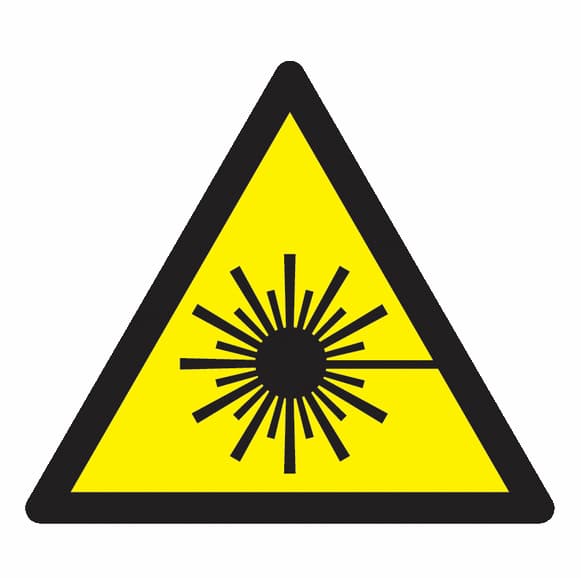
Class 1 is the lowest hazard classification. A Class 1 laser product is considered safe under all foreseeable conditions of normal use – no protective eyewear is required, no restricted access area is needed, and no additional safety controls are mandated beyond the product itself.
There are two ways a product can achieve Class 1 status. The first is through inherently low output power – the laser simply cannot emit enough energy to exceed the maximum permissible exposure (MPE) for the eye or skin. The second, and more relevant for industrial applications, is through full enclosure: the laser source itself may be a high-power Class 4 device, but it is housed within an interlocked enclosure that prevents any accessible radiation from reaching the operator during normal use. We’ll come back to this in more detail below.
Examples of Class 1 products that most people encounter in daily life include laser printers, CD and DVD players, and barcode scanners built into retail checkout systems.
Class 1M – Safe Unless Viewed Through Optical Instruments
Class 1M lasers are safe for viewing with the naked eye but could present a hazard if the beam is collected and focused by optical instruments such as microscopes, binoculars, or magnifying lenses. The ‘M’ stands for ‘magnification’.
In practice, Class 1M products are encountered primarily in telecommunications and measurement applications – fibre optic communication systems and some industrial alignment tools, for example. They are relatively uncommon in direct part marking contexts.
Class 2 – Visible Beam, Protected by Blink Reflex
Class 2 lasers emit visible light in the wavelength range of 400 to 700 nm, at a maximum continuous power of 1 mW. The classification is based on the natural aversion response: when a person is exposed to a bright visible beam, the blink reflex and instinctive head movement will normally limit the exposure to less than 0.25 seconds – short enough that no eye damage results.
Class 2 lasers are not considered hazardous for accidental momentary exposure, but intentional staring directly into the beam would be dangerous. Red laser pointers are the most familiar example.
Class 2M – Visible Beam, Hazardous With Optical Instruments
Class 2M follows the same logic as Class 2 – the blink reflex provides protection – but the beam profile means that optical instruments could focus the beam to a dangerous intensity before the reflex has time to respond. As with Class 1M, this class is most commonly encountered in specialised measurement and alignment applications.
Class 3R – Limited Risk, Careful Handling Required
Class 3R lasers (formerly Class IIIa in the older US classification system) occupy a middle ground. For visible-wavelength lasers, the limit is 5 mW – five times the Class 2 limit. The risk of injury from a momentary exposure remains low, but direct viewing of the beam or extended exposure can cause eye damage. Protective eyewear is advisable but not always mandatory, depending on the application and the specific exposure conditions.
Class 3R lasers appear in some consumer and professional applications – certain laser levels used in construction, for example – but are not typically the class associated with industrial part marking.
Class 3B – Direct Viewing Always Hazardous
Class 3B represents a significant step up in hazard level. These lasers emit continuous-wave power up to 500 mW, and direct exposure to the beam will cause eye injury. The saving grace of Class 3B, compared to Class 4, is that diffuse reflections from a matt surface are generally not hazardous at normal viewing distances – the beam is scattered rather than focused.
Class 3B lasers require engineering controls: restricted access areas, appropriate safety eyewear matched to the laser wavelength, and written operating procedures. A laser safety officer (LSO) is typically required. These lasers appear in research environments, some physiotherapy equipment, and certain industrial measurement systems.
Class 4 – The Highest Hazard Classification
Class 4 is the most hazardous category, covering lasers that exceed the output limits of Class 3B – in practice, continuous-wave systems above 500 mW. Class 4 lasers can cause severe and immediate eye and skin damage from direct exposure, and critically, they can also cause injury from diffuse reflections – the scattered light that bounces off a workpiece or surrounding surface.
Class 4 lasers may also present a fire hazard. At sufficient power, the beam can ignite combustible materials – a significant consideration in any production environment where oils, coolants, or packaging materials might be present.
Most industrial lasers used for cutting, welding, and marking – including the high-power fibre lasers at the heart of marking machines – are Class 4 sources. The power levels required to engrave metal, anneal stainless steel, or ablate coatings simply fall within Class 4 by definition.
This does not mean that industrial laser marking machines are inherently dangerous to operate. It means that the laser source inside the machine requires an appropriate engineering solution – which brings us to the concept of the embedded laser.
The Embedded Laser: How Class 4 Becomes Class 1
This is the part that matters most for manufacturers evaluating industrial laser marking equipment.
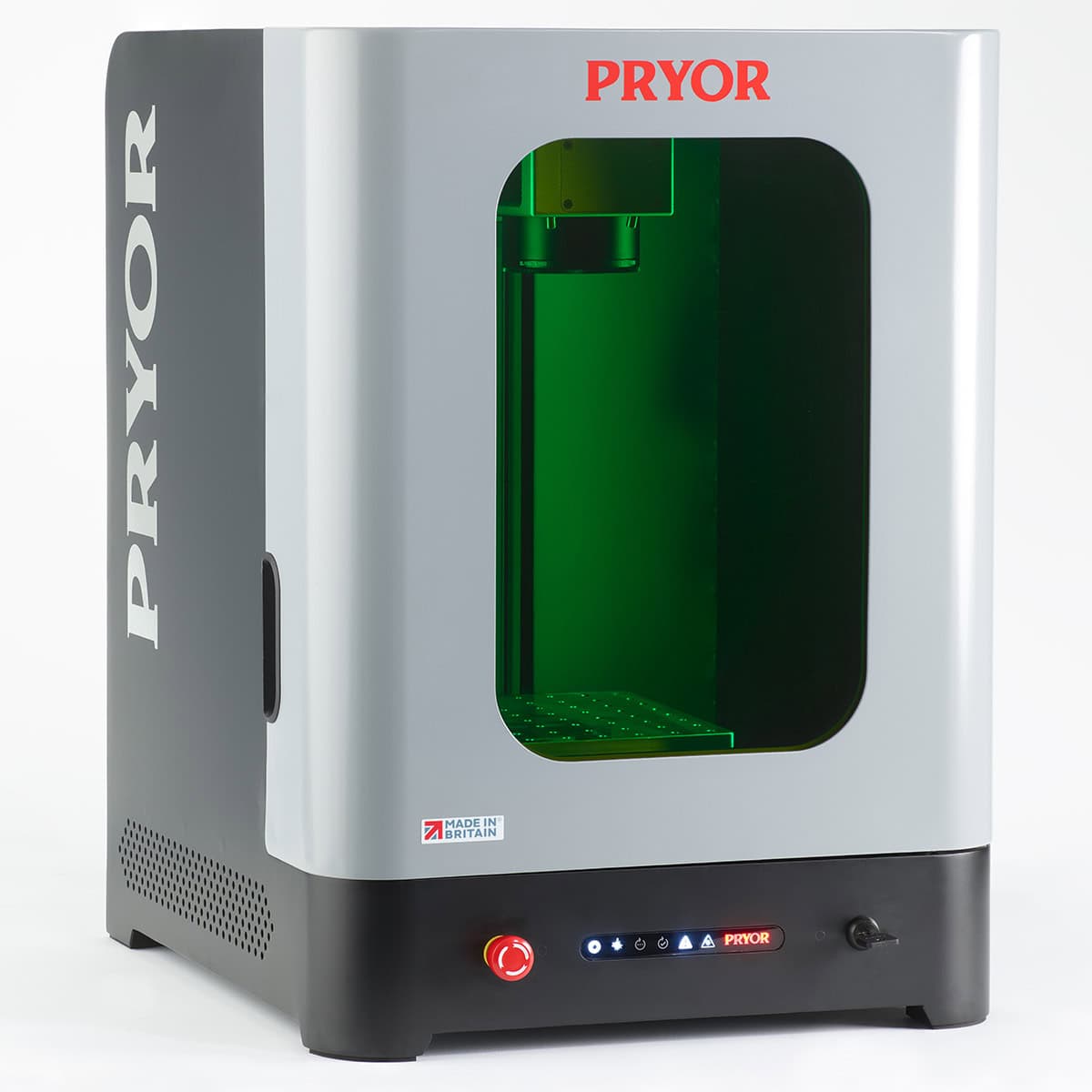
IEC 60825-1 explicitly permits a high-class laser to be incorporated into a product that itself is classified at a lower class – provided that the product’s design ensures no accessible hazardous radiation can reach the operator under normal operating conditions. The internal laser is referred to as an ’embedded laser’, and the product classification reflects the safety of the overall system, not just the source inside it.
In practice, this means that an industrial laser marking machine containing a 20W, 30W or 50W fibre laser – a Class 4 source by any measure – can be legitimately classified and labelled as a Class 1 product, provided:
- The enclosure is fully interlocked, so that opening any access panel or door during operation immediately stops the laser.
- No aperture in the enclosure allows accessible laser radiation to escape during normal use.
- Diffuse reflections from the marking process are contained within the enclosure and cannot reach the operator.
- The enclosure design has been assessed and the product classified correctly under the standard.
This is not a loophole or a classification technicality. It is the mechanism by which safe industrial laser products are engineered – and it is the reason why manufacturers can operate powerful laser marking machines on a production floor without laser safety eyewear, without a designated hazard zone, and without a dedicated laser safety officer. The engineering does the work.
What Laser Classification Means When You’re Buying a Marking Machine
When comparing laser marking machines, the classification of the overall system – not just the power of the internal laser source – is what determines the practical safety requirements for your facility.
A machine classified as Class 1 can be operated in an open production environment without special access restrictions or laser-specific PPE. The enclosure handles everything. A machine whose classification is Class 3B or Class 4 – perhaps because the marking head is open rather than enclosed, or because the enclosure does not fully contain the beam path – requires a very different level of operational control, regardless of whether the underlying laser power is the same.
There are open-beam laser systems on the market – often at lower price points – where the operator has access to the beam path during marking. These may be appropriate in controlled environments with trained operators and appropriate safety infrastructure, but for most manufacturing production floors they introduce a level of complexity and ongoing risk management that an enclosed Class 1 system simply does not require.
The questions worth asking of any prospective supplier are:
- Is the system classified as Class 1 for the complete product as supplied, not just the laser source?
- Is the enclosure fully interlocked on all access panels, including any part-loading doors or windows?
- Has the classification been assessed by the manufacturer, and is it documented with the machine?
- What PPE, if any, is required for normal operation?
- What controls are needed when the enclosure is open for maintenance or servicing?
 Pryor’s Laser Marking Machines: Built to Class 1 Safety Standards
 Pryor’s Laser Marking Machines: Built to Class 1 Safety Standards
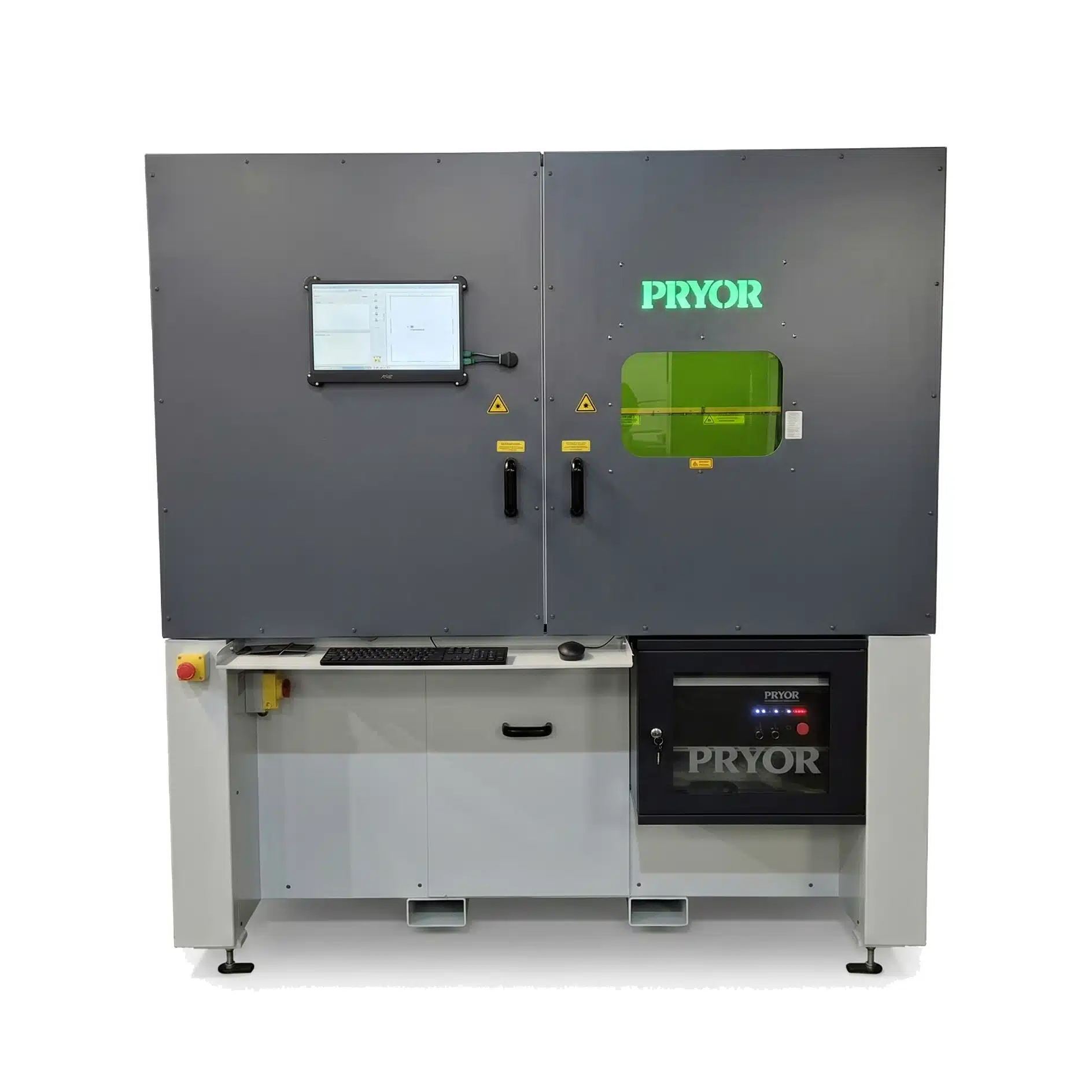
Every laser marking machine in Pryor’s range is designed and built to operate as a Class 1 laser-safe system. The fibre laser sources we use – whether 20W or 50W pulsed units – are Class 4 by output specification, but they are always enclosed within fully interlocked housings that prevent any accessible laser radiation from reaching the operator during normal use.
Our Bench Laser and Laser Workstation systems feature fully enclosed cabinets with automated or manually interlocked access doors, key-switch interlock control, and emergency stop systems integrated as standard. The portable laser systems we manufacture – designed for marking large or immobile components in the field – use a different approach: a rubberised mask with multiple contact sensors and a vacuum detection system that ensures the device is only operable when correctly seated against a surface, achieving Class 1 classification through a contact-seal approach rather than a full enclosure.
In each case, the classification is a product-level assessment of the complete system as supplied to the customer – not a claim about the internal laser source in isolation.
All our systems are supplied with documentation covering the laser classification, safety interlock configuration, and maintenance requirements – including the precautions required when the enclosure is open during servicing. For customers with formal laser safety management programmes, we can provide the technical information needed to support that process.
One More Safety Consideration: Fume and Particulate
Laser classification addresses optical radiation hazards – the risk of harm from the beam itself. It does not cover the fume and particulate that laser marking can generate. When a laser interacts with metal, coatings, or plastics, the process can produce fine particles and volatile organic compounds that require extraction.
This is a separate safety consideration from laser class, but one that should not be overlooked when specifying a laser marking system. Our workstation and bench systems can be specified with integrated fume extraction as part of the installation, and we can advise on the appropriate extraction specification for your marking application.
Choosing the Right Laser Marking System
If you’re in the process of specifying a laser marking equipment– whether for a new production line, a replacement system, or an expansion of your traceability capability – the classification of the system as supplied is one of the most practical things to confirm early in the conversation.
We work with manufacturers across aerospace, automotive, medical, energy, and general engineering. Our technical team can talk through your application requirements, the parts you’re marking, your production environment, and the safety and compliance framework you’re working within, and help you identify the right solution.
Call us on +44 114 2766044, or get in touch via our contact us page. If you know what you’re marking and what the environment looks like, we can usually have a useful conversation straight away.