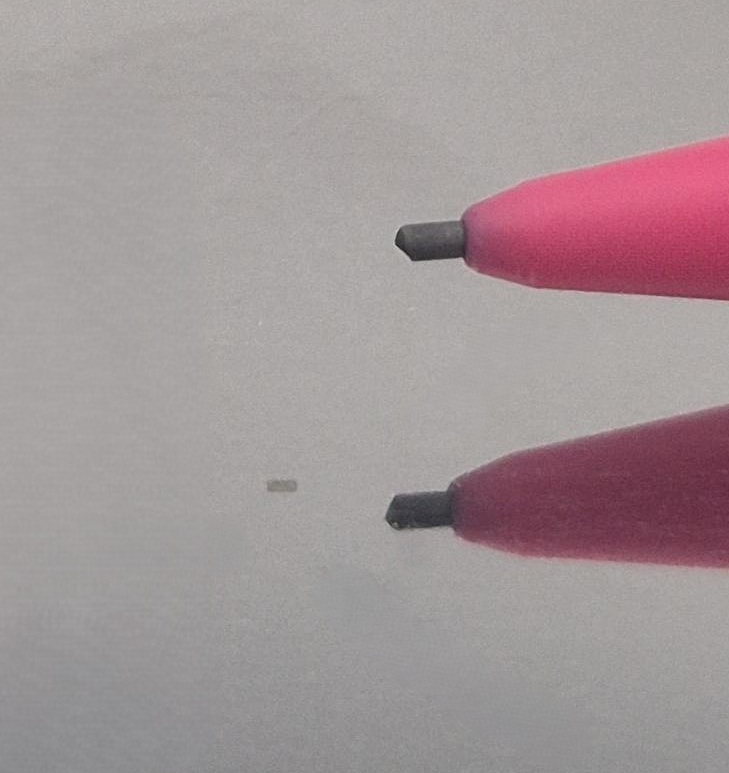
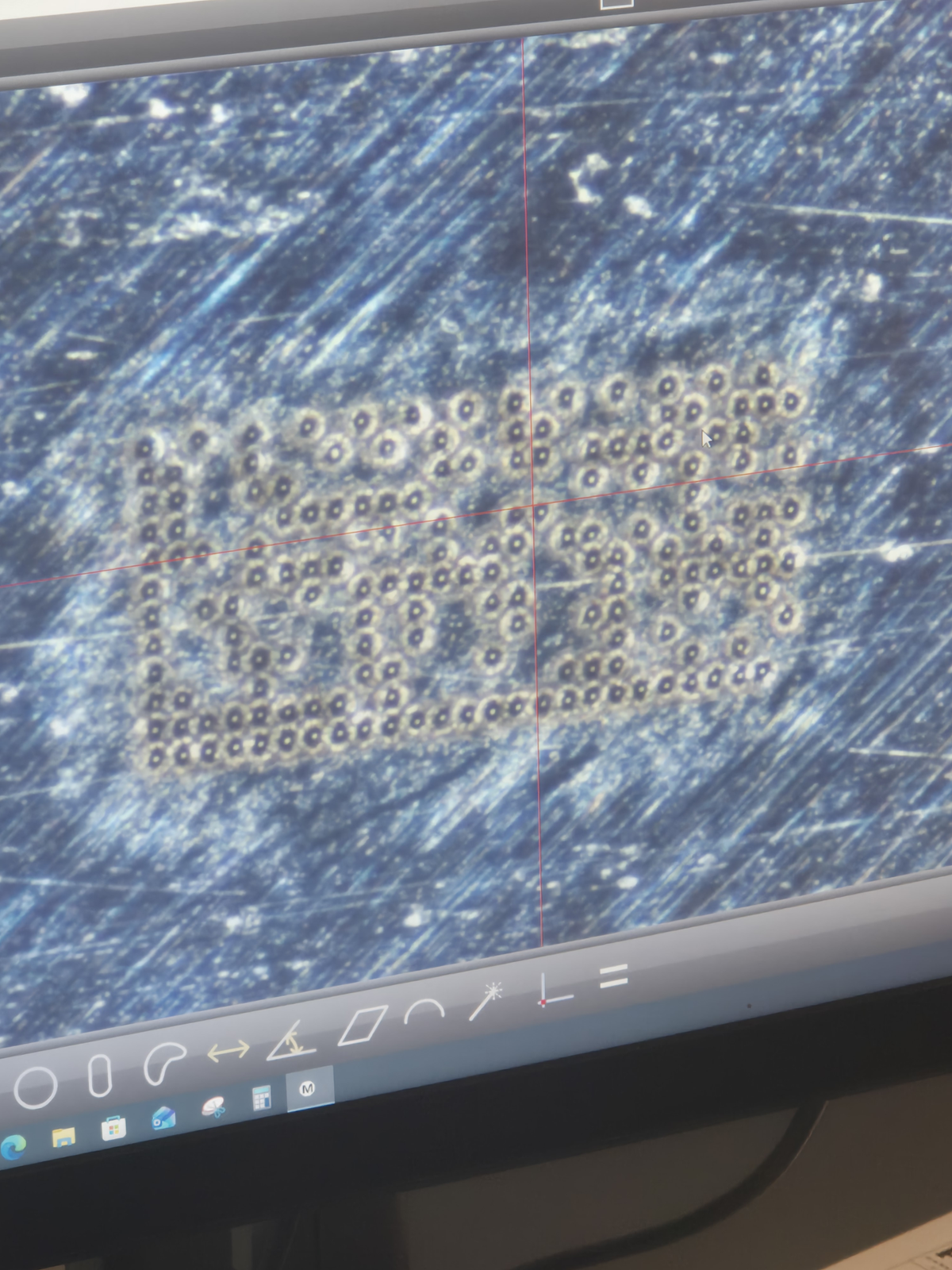
Micro Data Matrix code with a 0.7mm pencil for scale
Pushing the Limits of Micro-Marking: How Small Can a Laser Datamatrix Code Really Be?
There’s a question that comes up now and then in marking conversations: how small can a datamatrix code actually go and still work?
Not “quite” small. Not “barely readable” small. Properly machine-readable small.
Recently, that question stopped being theoretical for us. Two customer enquiries landed at almost the same time. Both wanted micro datamatrix codes at sizes most people would dismiss outright. One needed a code inside a 1 × 1 mm area. The other asked for something below 0.25 × 0.50 mm. At that scale, you’re not just shrinking a code. You’re flirting with physics. We’re always looking to innovate and move technology forward, so we tested it.
What followed was less a routine application trial and more a limit-finding exercise.
Why does anyone want codes this small?
Miniaturisation isn’t slowing down. Electronics are shrinking. Aerospace components are getting lighter and denser. Medical and high-precision parts keep losing spare surface area. Yet traceability demands haven’t relaxed, if anything, they’ve tightened.
Manufacturers still need:
Unique identification
Production traceability
Compliance marking
Anti-counterfeit measures
The awkward truth is? Many parts are now so small that marking feels like an afterthought squeezed into a corner. That’s where ultra-small datamatrix codes start to matter. The codes being small doesn’t matter if they are too small to be readable.
The usual limits of small codes
In theory, you can scale a datamatrix down endlessly in software. The layout will still exist. The pattern still looks ok on screen, but the reality is harsher.
At the micro scale, three things fight you:
1) Heat spread Laser energy doesn’t politely stay inside a tiny square. It bleeds. Adjacent cells start to blur together.
2) Contrast loss If cells aren’t cleanly separated, vision systems struggle to distinguish light from dark.
3) Optics Even if you mark perfectly, the camera has to see it. Quite often, that’s the bigger challenge.
So yes, small codes exist. But reliably small and verifiable codes? That’s rarer.
Starting simple
We began with a 26 × 12 datamatrix layout and gradually reduced its size. First attempts used a familiar method: marking the outline of each cell and reducing fill to create small dots.
On paper, sensible. On parts, not great.
Cells started interfering with each other. The thermal footprint was simply too large relative to the cell size. Clean geometry turned into muddy clusters.
Readable? No. Repeatable? Definitely not.
Time to change approach.
The spiral fill shift
A newer fill mode in the software uses spiral paths to fill a cell either from the outside in or inside out. Instead of dumping energy across an area, it controls how heat is deposited.
Think of it as drawing a dot rather than painting a square. By shortening the spiral length, we could form extremely small, controlled marks. That reduced thermal bleed between cells and preserved separation. At this point, something clicked.
The problem wasn’t positioning accuracy. The lasers were placing marks exactly where commanded. The real battle was energy control inside each cell. Once that was managed, code quality improved dramatically. And the size kept shrinking.
Reaching microscopic territory
We pushed the size down to around 0.25 × 0.50 mm for a 26 × 12 datamatrix. That’s already tiny on paper. Under a microscope, it looks almost unreal. Put another way: the whole code is no wider than roughly six human hairs. Let that sink in for a moment.
A full machine-readable datamatrix code, smaller than something you can barely see unaided. We’ll be careful here, but it’s fair to say this may be among the smallest machine-readable datamatrix codes ever produced with standard industrial equipment. It could even be the world’s smallest of its kind. Proving that globally is tricky, but the scale is genuinely at the edge of what’s practical.
Marking was only half the story
Here’s the twist; marking at this size isn’t the hardest part, reading it is.
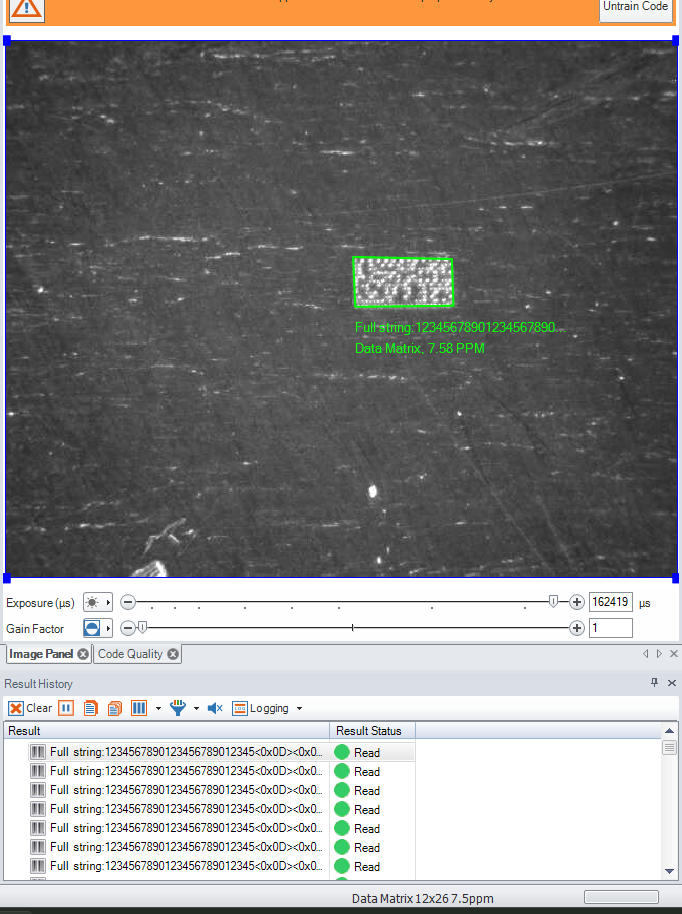
A standard vision setup simply couldn’t resolve the detail. Even high-quality lenses struggled at normal configurations. At this size, you’re doing microscopy, not routine inspection. By experimenting with lens spacers, we altered the sensor-to-lens distance to push magnification further. Around 60 mm of extension turned out to be the practical ceiling before focus became impossible.
With that setup, the camera could finally capture a clear image. After training and tuning, we achieved consistent positive reads. That was the real win.
A tiny mark is interesting. A verifiable tiny mark is useful.
What this means in practice
This isn’t about making everything microscopic for the sake of it. Most applications don’t need this scale.
But for manufacturers dealing with:
Micro-electronics
Miniature aerospace parts
Precision components
Delicate or space-limited items
…it changes what’s possible.
Parts once labelled “too small to mark” may no longer be off-limits. Designers get more freedom. Traceability doesn’t have to be sacrificed for size. And notably, this was achieved with standard laser systems and software, not exotic lab equipment.
So, how small can a datamatrix code be?
Smaller than many assume. Smaller than most specifications ever demand. Potentially as small as a fraction of a millimetre while staying machine-readable.
Are there limits? definitely. Material, contrast, lighting, and optics all matter. Repeatability across materials needs more exploration too. But the ceiling has clearly moved. And that’s the interesting part. Not just how small we went this time, but how far the boundary shifted.
Because once a limit moves, new applications appear almost immediately. If you’re working with tiny parts and assumed datamatrix marking wasn’t realistic, it might be time to revisit that assumption. The space available on a component is shrinking, but marking technology isn’t standing still. Pryor has been at the forefront of pushing marking technology development for longer than most companies have existed, and we don’t intend to stop any time soon.